Make a learning plan
Subjects are required to enrich their learner profiles by regularly making plans and setting goals according to their own situation, monitoring and evaluating your study. Because it can help you prepare for the 1z0-082 Korean exam. If you want to succeed in your exam and get the related exam, you have to set a suitable study program. If you decide to buy the 1z0-082 Korean reference materials from our company, we will have special people to advise and support you. Our staff will also help you to devise a study plan to achieve your goal. We believe that if you purchase 1z0-082 Korean test guide from our company and take it seriously into consideration, you will gain a suitable study plan to help you to pass your exam in the shortest time.
Correct your mistake
It is known to us that the error correction is very important for these people who are preparing for the 1z0-082 Korean exam in the review stage. It is very useful and helpful for a lot of people to learn from their mistakes, because many people will make mistakes in the same way, and it is very bad for these people to improve their accuracy. If you want to correct your mistakes when you are preparing for the 1z0-082 Korean exam, the study materials from our company will be the best choice for you. Because our 1z0-082 Korean reference materials can help you correct your mistakes and keep after you to avoid the mistakes time and time again. We believe that if you buy the 1z0-082 Korean exam prep from our company, you will pass your exam in a relaxed state.
Develop good study habits
Just like the old saying goes, motivation is what gets you started, and habit is what keeps you going. A good habit, especially a good study habit, will have an inestimable effect in help you gain the success. The 1z0-082 Korean exam prep from our company will offer the help for you to develop your good study habits. If you buy and use our study materials, you will cultivate a good habit in study. More importantly, the good habits will help you find the scientific prop learning methods and promote you study efficiency, and then it will be conducive to helping you pass the 1z0-082 Korean exam in a short time. So hurry to buy the 1z0-082 Korean test guide from our company, you will benefit a lot from it.
There are more and more people to try their best to pass the 1z0-082 Korean exam, including many college students, a lot of workers, and even many housewives and so on. These people who want to pass the 1z0-082 Korean exam have regard the exam as the only one chance to improve themselves and make enormous progress. So they hope that they can be devoting all of their time to preparing for the 1z0-082 Korean exam, but it is very obvious that a lot of people have not enough time to prepare for the important exam. Just like the old saying goes, the spirit is willing, but the flesh is week. We are glad to tell you that the 1z0-082 Korean exam prep from our company will help you solve your problem in a short time.

Topics of Oracle 1z0-082: Oracle Database Administration I Exam
The Oracle 1Z0-068 practice exams the abilities and knowledge of the candidates by checking the following objectives of 1z0-068 exam dumps:
Understanding Oracle Database Architecture - Oracle Database: Administration Workshop
- Understanding Oracle Database Memory and Process Structures
- Understanding Logical and Physical Database Structures
- Understanding Oracle Database Instance Configurations
- Understanding Oracle Database Server Architecture
Managing Database Instances - Oracle Database: Administration Workshop
- Shutting Down Oracle Database Instances
- Starting Up Oracle Database Instances
- Managing Initialization Parameter Files
- Using the Automatic Diagnostic Repository (ADR)
- Using Dynamic Performance Views
- Using the Alert Log and Trace Files
- Using Data Dictionary Views
Managing Users, Roles, and Privileges - Oracle Database: Administration Workshop
- Assigning Quotas to Users
- Managing Oracle Database Users, Privileges, and Roles
- Administering User Authentication Methods
- Applying the Principle of Least Privilege
- Creating and Assigning Profiles
Managing Storage - Oracle Database: Administration Workshop
- Deferring Segment Creation
- Using Table and Row Compression
- Managing Different Types of Segments
- Deploying Oracle Database Space Management Features
- Managing Resumable Space Allocation
- Shrinking Segments
- Understanding Block Space Management
- Using Space-Saving Features
Moving Data - Oracle Database: Administration Workshop
- Using External Tables
- Using SQL Loader
- Using Oracle Data Pump
Accessing an Oracle Database with Oracle supplied Tools - Oracle Database: Administration Workshop
- Using oracle enterprise Manager Database Express
- Using Oracle Enterprise Manager Cloud Control
- Using the Database Configuration Assistant (DBCA)
- Using SQL Plus
- Using SQL Developer
Configuring Oracle Net Services - Oracle Database: Administration Workshop
- Using Oracle Net Services Administration Tools
- Configuring the Oracle Net Listener
- Connecting to an Oracle Database Instance
- Configuring Communication Between Database Instances
- Comparing Dedicated and Shared Server Configurations
- Administering Naming Methods
Managing Tablespaces and Datafiles - Oracle Database: Administration Workshop
- Creating, Altering, and Dropping Tablespaces
- Implementing Oracle Managed Files
- Viewing Tablespace Information
- Managing Table Data Storage
- Moving and Renaming Online Data Files
Managing Undo - Oracle Database: Administration Workshop
- Comparing Undo Data and Redo Data
- Limiting Rows Returned in a SQL Statement
- Using Substitution Variables
- Configuring Undo Retention
- Storing Undo Information
- Using the DEFINE and VERIFY commands
- Restricting and Sorting Data - Oracle Database: Introduction to SQL
- Understanding Temporary Undo
- Applying Rules of precedence for operators in an expression
- Understanding Transactions and Undo Data
Using Conversion Functions and Conditional Expressions - Oracle Database: Introduction to SQL
- Nesting multiple functions
- Manipulating dates with the date function
- Using The MINUS operator
- Using Single-Row Functions to Customize Output - Oracle Database: Introduction to SQL
- Using The DESCRIBE command
- Using concatenation operator, literal character strings, alternative quote operator, and the DISTINCT keyword
- Using Arithmetic expressions and NULL values in the SELECT statement
- Understanding implicit and explicit data type conversion
- Understanding Data Definition Language - Oracle Database: Introduction to SQL
- Using Non-equijoins
- Displaying Data from Multiple Tables Using Joins - Oracle Database: Introduction to SQL
- Applying the NVL, NULLIF, and COALESCE functions to data
- Using SET Operators - Oracle Database: Introduction to SQL
- Using OUTER joins
- Managing Views - Oracle Database: Introduction to SQL
- Using Self-joins
- Using Column aliases
- Using the ORDER BY clause in set operations
- Using the TO_CHAR, TO_NUMBER, and TO_DATE conversion functions
- Working with INTERVAL data types
- Using The UNION and UNION ALL operators
- Using The INTERSECT operator
- Managing Views
- Working with CURRENT_DATE, CURRENT_TIMESTAMP, and LOCALTIMESTAMP
- Manipulating strings with character functions in SQL SELECT and WHERE clauses
- Performing arithmetic with date data
- Managing Data in Different Time Zones - Oracle Database: Introduction to SQL
- Using Various Types of Joins
- Using The SQL SELECT statement
- Retrieving Data using the SQL SELECT Statement - Oracle Database: Introduction to SQL
- Manipulating numbers with the ROUND, TRUNC, and MOD functions
- Matching the SELECT statements
- Using Data Definition Language
Reporting Aggregated Data Using Group Functions - Oracle Database: Introduction to SQL
- Managing Database Transactions
- Controlling transactions
- Using Multiple Row Subqueries
- Using Group Functions
- Managing Schema Objects - Oracle Database: Introduction to SQL
- Restricting Group Results
- Creating and using temporary tables
- Using Data Manipulation Language
- Managing Sequences, Synonyms, Indexes - Oracle Database: Introduction to SQL
- Managing Sequences
- Using Single-Row Subqueries
- Creating Groups of Data
- Managing Indexes
- Managing Tables using DML statements - Oracle Database: Introduction to SQL
- Using Subqueries to Solve Queries - Oracle Database: Introduction to SQL
- Managing constraints
- Managing Synonyms
Reference: https://education.oracle.com/oracle-database-administration-i/pexam_1Z0-082
How to Prepare for Oracle 1z0-082: Oracle Database Administration 1 Exam
Preparation Guide for Oracle 1z0-082: Oracle Database Administration 1 Exam
Introduction
Oracle, based in California, is an American multinational Information Technology company. Oracle is an international company that develops software applications for business. To help enterprises develop their operations, Oracle provides a variety of cloud-based applications and systems as well as hardware and services. Data management, business analytics, IT operations management, enterprise resource planning, security, and emerging technologies are the focus of Oracle's applications. Oracle is best known for its database software and technology. Oracle Database, a relational Database Management System (DBMS), is one of the most popular corporate database products.
Oracle also develops and builds tools and technologies for database management systems for middle-tier applications, Human Capital Management systems (HCM), Customer Relationship Management systems (CRM), Enterprise Resource Planning systems (ERP), and Supply Chain Management systems (SCM). Oracle Database commonly known as Oracle Database Management System (DBMS) is a multi-model database management system. It is a widely used database to run tasks for Data warehousing and Online Transaction processing databases. Different service providers make Oracle Database accessible on cloud, premises, or a hybrid cloud installation.
Oracle 1z0-082 Korean Exam Syllabus Topics:
| Section | Objectives |
|---|---|
| Topic 1: Backup and Recovery Concepts | - RMAN fundamentals - Backup and restore operations |
| Topic 2: Database Administration | - Managing database objects - Managing users and privileges |
| Topic 3: Database Storage Structures | - Tablespaces and datafiles - Control files and redo logs |
| Topic 4: Monitoring and Performance Management | - Performance tuning basics - Database monitoring tools |
| Topic 5: Multitenant Architecture | - Managing pluggable databases - Container and pluggable databases (CDB/PDB) |
| Topic 6: Database Installation and Configuration | - Installing Oracle Database software - Creating and configuring a database |
| Topic 7: Oracle Database Architecture | - Physical database structure - Database instance and memory structures |
Oracle Database Administration I (1z0-082 Korean Version) Sample Questions:
기존 경로 SQL 로드에 대한 다음 두 가지 설명 중 맞는 것은 무엇입니까? (두 가지를 선택하십시오.)
- A. 처리 중인 객체를 잠급니다.
- B. 항상 리두를 생성합니다.
- C. 참조 무결성 제약 조건을 적용합니다.
- D. 실행 취소를 생성하지 않습니다.
- E. 클러스터형 테이블에 데이터를 로드할 수 없습니다.
Correct Answer: C,D 🗳️
SCOTT/TIGER 사용자는 서로 다른 두 위치에 있는 BOSTON_DB와 DALLAS_DB라는 두 개의 데이터베이스에 존재합니다.
각 데이터베이스에는 DALLAS_DB를 서비스 이름으로 정의하는 tnsnames.ora 파일이 있습니다.
다음 명령어를 살펴보세요:
CREATE DATABASE LINK dblink1 CONNECT TO scott IDENTIFIED BY tiger USING
`dallas_db';
보스턴 데이터베이스의 SCOTT 사용자만 댈러스 데이터베이스의 SCOTT 스키마에 접근할 수 있도록 명령을 실행하려면 어떻게 해야 합니까?
- A. BOSTON_DB에서는 SCOTT, DALLAS_DB에서는 SYS로 기록됨
- B. 두 데이터베이스 모두에서 SYS로
- C. DALLAS_DB의 SCOTT으로
- D. BOSTON_DB의 SCOTT으로
- E. 두 데이터베이스 모두에서 SCOTT으로 표기됨
Correct Answer: B 🗳️
100개의 행을 포함하는 books 테이블에 대한 다음 설명을 검토하십시오.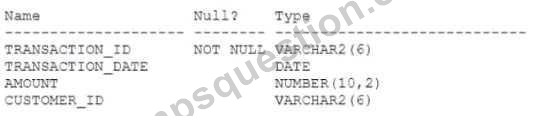
이제 새 세션에서 발행된 이 일련의 명령문을 검토하십시오.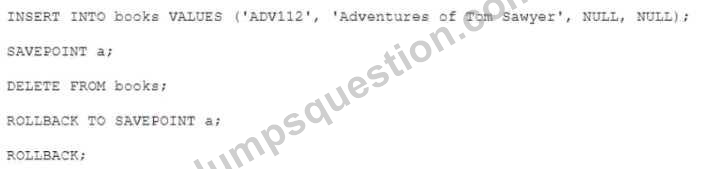
100개의 행을 포함하는 books 테이블에 대한 다음 설명을 검토하십시오.
다음 세 가지 진술이 사실입니까?
- A. 첫 번째 롤백 명령은 테이블의 원래 행 100개를 잠근 상태로 둡니다.
- B. 두 번째 롤백 명령은 롤백을 롤백하여 명령을 저장점으로 되돌립니다.
- C. 두 번째 롤백 명령은 삽입된 행을 복원합니다.
- D. 두 번째 롤백 명령은 원래 테이블에 있던 100개의 행을 복원합니다.
- E. 첫 번째 롤백 명령은 원래 테이블에 있던 100개의 행을 복원합니다.
- F. 첫 번째 롤백 명령은 삽입된 행을 잠근 상태로 둡니다.
- G. 첫 번째 RollBack 명령은 삽입된 행을 복원합니다.
Correct Answer: B,C,G 🗳️
이 명령과 일부 부분 출력을 검토하십시오.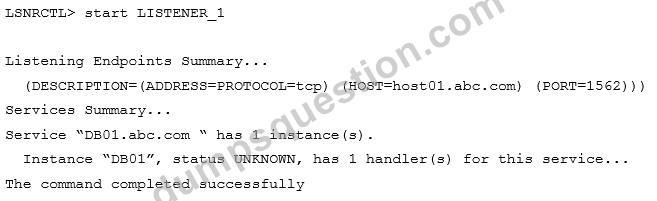
DB01.abc.com 서비스가 알 수 없는 상태를 표시하는 이유는 무엇입니까?
- A. LOCAL_LISTENER 데이터베이스 매개변수가 LISTENER_1을 참조하는 서비스 이름으로 설정되지 않았습니다.
- B. 서비스 DB01.abc.com이 정적으로 등록되었습니다.
- C. SID_LIST_LISTENER 섹션이 LISTENER.ORA 파일에 포함되어 있지 않습니다.
- D. 서비스 DB01.abc.com이 동적으로 등록됩니다.
- E. 수신기가 기본 포트 1521에서 수신하지 않습니다.
Correct Answer: A 🗳️
데이터베이스용 DBCA를 사용하여 수행할 수 있는 두 가지 작업은 무엇입니까? (두 가지를 선택하세요.)
- A. 사용 가능한 Enterprise Manager 관리 서버에 새 데이터베이스를 등록합니다.
- B. 새 데이터베이스에 대한 비표준 블록 크기 구성
- C. 기존 데이터베이스에 대해 플래시백 데이터베이스 활성화
- D. 기존 데이터베이스의 표준 블록 크기 변경
- E. 새 데이터베이스에 대한 증분 백업 구성
Correct Answer: A,D 🗳️
Explanation: Only visible for DumpsQuestion members. You can sign-up / login (it's free).
Viewing page 1 out of 33 pages.
Viewing questions 1-5 out of 165 questions.