

Get 100% Authentic Juniper JN0-105 Dumps with Correct Answers
New Training Course JN0-105 Tutorial Preparation Guide
Juniper JN0-105 Exam Syllabus Topics:
| Topic | Details |
|---|---|
| Topic 1 |
|
| Topic 2 |
|
| Topic 3 |
|
NEW QUESTION # 45
Exhibit
[edit system archival] user@router# show configuration {
transfer-on-commit; archive-sites {
"scp://[email protected] : /archive" password## SECRET-DATA
"ftp://[email protected]:/archive" password "$9..."; ## SECRET-DATA
.
Referring to the exhibit, where are the configuration backup files stored?
- A. Files are storedto the SCP site and the FTP site simultaneously.
- B. Files are storedto any site as selected by Junos internally.
- C. Files are storedto the SCP site and the FTP site in a round-robinmanner.
- D. Files are storedto the SCP site but if the transfer fails, then to theFTP site.
Answer: A
Explanation:
In Junos OS, thearchivalconfiguration under[edit system]allows for the automatic backup of configuration files to designated locations upon commit. When multiplearchive-sitesare specified, as shown in the exhibit with both SCP and FTP sites listed, the device does not choose between them or use them in a round-robin manner. Instead, it attempts to transfer the configuration backup files to all specified sites simultaneously upon each commit. This ensures redundancy and increases the likelihood that a backup will be successfully stored even if one of the transfer methods or destinations fails.
NEW QUESTION # 46
You have logged on to a Junos device and are at the operational mode prompt.
Which two commands are used at this prompt? (Choose two.)
- A. show interface ge-0/0/0
- B. request system shutdown
- C. set interface ge-0/0/0 unit 0 family inet
- D. run show interface terse
Answer: A,B
Explanation:
At the operational mode prompt on a Junos device, you can use various commands to view the device's status and request system operations. The show interface ge-0/0/0 command is used to display information about a specific interface, while the request system shutdown command is used to properly shut down the device.
The set command is used in configuration mode, not operational mode, and the run command is used to execute operational mode commands from configuration mode.
NEW QUESTION # 47
You have logged on to a Junos device and are at the operational mode prompt.
Which two commands are used at this prompt? (Choose two.)
- A. show interface ge-0/0/0
- B. set interface ge-0/0/0 unit 0 family inet
- C. request system shutdown
- D. run show interface terse
Answer: A
Explanation:
At the operational mode prompt on a Junos device, you can use various commands to view the device's status and request system operations. The show interface ge-0/0/0 command is used to display information about a specific interface, while the request system shutdown command is used to properly shut down the device.
The set command is used in configuration mode, not operational mode, and the run command is used to execute operational mode commands from configuration mode.
NEW QUESTION # 48
Which two statements are correct about Junos traceoptions? (Choose two.)
- A. Traceoptions cannot be enabled in a production environment.
- B. Traceoptions are enabled through configuration.
- C. Traceoption output, by default, is stored in /var/iog/<fiie-name>.
- D. Traceoptions are enabled by default.
Answer: B,C
NEW QUESTION # 49
Which command displays all IPv6 routes in the default routing instance?
- A. showroute table inet.l
- B. showroute table inet6.1
- C. showroute table inet6.0
- D. showroute table inet.0
Answer: C
Explanation:
In Junos OS, the command to display IPv6 routes in the default routing instance isshow route table inet6.0.
The routing tableinet6.0specifically holds IPv6 routes. The commandshow route table inet.0is used for IPv4 routes, andinet6.1orinet.l(assuminginet.lis a typo forinet.1) are not standard Junos routing tables for displaying IPv6 routes in the default routing instance.
NEW QUESTION # 50
Which prompt indicates that you are using configuration mode?
- A. $
- B. >
- C. %
- D. #
Answer: D
Explanation:
In Junos OS, the # prompt indicates that you are in configuration mode. This mode is used for making changes to the configuration of the device.
Reference: Juniper Networks CLI Modes
"The # prompt indicates that you are in configuration mode."
NEW QUESTION # 51
How many rescue configuration files are supported on a Junos device?
- A. 0
- B. 1
- C. 2
- D. 3
Answer: A
Explanation:
Junos OS supports only 1 rescue configuration file on a device. This rescue configuration is a safeguard feature that allows network administrators to revert to a known good configuration in case of a configuration error or issue, ensuring network stability.
In Junos OS, each device supports only one rescue configuration file. The rescue configuration is a specific configuration that can be saved and later retrieved if needed. This is used as a fallback configuration that you know works and can be applied in case of an emergency or if the current configuration has issues.
Reference:
"You can create a rescue configuration file by using the request system configuration rescue save operational mode command. Each Junos OS device can have only one rescue configuration file."
NEW QUESTION # 52
Which prompt indicates that you are using configuration mode?
- A. $
- B. >
- C. %
- D. #
Answer: D
Explanation:
In Junos OS, the # prompt indicates that you are in configuration mode. This mode is used for making changes to the configuration of the device.
Reference:
"The # prompt indicates that you are in configuration mode."
NEW QUESTION # 53
You are creating a new policy to accept and redistribute routes into your IGP.
In this scenario, which match criteria would you use to identify the route prefixes to select?
- A. route-type
- B. neighbor
- C. instance
- D. route-filter
Answer: D
Explanation:
When creating a new policy to accept and redistribute routes into your Interior Gateway Protocol (IGP), the route-filter match criteria is used to identify the route prefixes to select. The route-filter statement specifies which prefixes should be matched in a policy. This allows for precise control over which routes are accepted and redistributed, facilitating efficient and secure routing policies within the network.
References:
* "show | display set | match ge-0/0/2" indicating command examples and match criteria from Useful Juniper Commands.txt.
* Juniper official documentation: Routing Policy and Firewall Filters Configuration Guide.
NEW QUESTION # 54
Click the Exhibit button.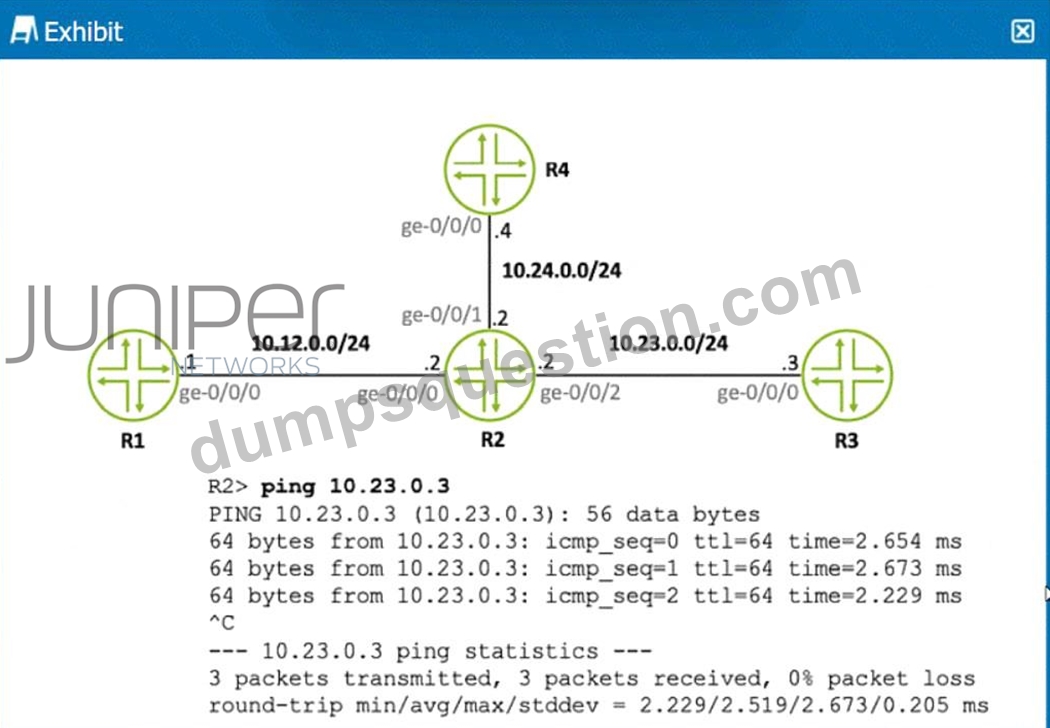
Referring to the exhibit, what is the source IP address of the ping that was executed?
- A. 10.12.0.2
- B. 10.23.0.3
- C. 10.23.0.2
- D. 10.24.0.4
Answer: C
Explanation:
The exhibit shows a ping test being executed from router R2 to the IP address 10.23.0.3. Since the ping command is issued on R2 and we see successful replies from 10.23.0.3, it means the source of the ping must be an interface on R2. Given the network diagram and the IP address scheme, the source IP address of the ping is on the interface ge-0/0/2 of R2, which is in the subnet 10.23.0.0/24. The only logical IP address for R2's interface in this subnet, based on standard networking practices and the given options, would be
10.23.0.2. The other addresses provided in the options belong to different subnets or are the destination of the ping itself.
NEW QUESTION # 55
Which two statements are correct about Junos traceoptions? (Choose two.)
- A. Traceoptions cannot be enabled in a production environment.
- B. Traceoptions are enabled through configuration.
- C. Traceoption output, by default, is stored in /var/iog/<fiie-name>.
- D. Traceoptions are enabled by default.
Answer: B,C
Explanation:
Traceoptions in Junos OS are used for detailed debugging and troubleshooting of protocols and processes within the system. They are not enabled by default due to the potential performance impact and volume of data generated. Instead, traceoptions are enabled through specific configuration settings under the relevant protocol or process hierarchy. This allows administrators to target their troubleshooting efforts and control the scope of logging. By default, the output generated by traceoptions is stored in files located in the /var/log directory, with the file name typically specified in the traceoptions configuration. This structured approach to logging and debugging helps in diagnosing complex issues without overwhelming the system or the administrator with irrelevant data.
NEW QUESTION # 56
Which command modifier would you use to see all possible completions for a specific command?
- A. ?
- B. |
- C. extensive
- D. detail
Answer: A
Explanation:
In Junos OS, the ? command modifier is used to display all possible completions for a specific command. This helps users understand the available options and syntax for a command they are trying to use.
Reference: Juniper Networks CLI Documentation
"Use the ? command modifier to display all possible completions for a specific command."
NEW QUESTION # 57
You are logged in to a Junos OS device with SSH and issued the show protocols | compare command in the configuration, but no output is shown.
Which statement is correct in this scenario?
- A. Someone accidentally deleted the active configuration.
- B. You must commit the configuration before any output will be shown.
- C. There are no changes to the candidate configuration.
- D. The command only works for interface configuration differences.
Answer: C
Explanation:
The show | compare command in Junos OS is used to display the differences between the candidate configuration and the active configuration. If no output is shown when you issue this command, it means that there are no changes between the candidate configuration and the active configuration. This indicates that the candidate configuration is identical to the active configuration, and thus no differences are displayed.
Reference:
"The show | compare command displays the differences between the candidate configuration and the active configuration. If there are no changes, no output is displayed."
NEW QUESTION # 58
Which two statements are correct regarding Layer 2 network switches? (Choose two.)
- A. Switches are susceptible to traffic loops.
- B. Switches create a single collision domain.
- C. Switches flood broadcast traffic.
- D. Switches do not learn MAC addresses.
Answer: A,C
Explanation:
Layer 2 network switches are crucial components in local area networks (LANs), providing multiple functions for data packet forwarding and network segmentation. One inherent characteristic of switches is their susceptibility to traffic loops, especially in networks with redundant paths. Without proper loop prevention protocols like Spanning Tree Protocol (STP), loops can cause broadcast storms and network instability. Additionally, switches inherently flood broadcast traffic to all ports within the broadcast domain, except the port on which the broadcast was received. This is because broadcast frames are meant to be delivered to all devices within the VLAN, and the switch ensures this by flooding these frames to all ports in the VLAN, except the source port.
NEW QUESTION # 59
You are creating a new policy to accept and redistribute routes into your IGP.
In this scenario, which match criteria would you use to identify the route prefixes to select?
- A. route-type
- B. neighbor
- C. instance
- D. route-filter
Answer: D
Explanation:
When creating a new policy to accept and redistribute routes into your Interior Gateway Protocol (IGP), the route-filter match criteria is used to identify the route prefixes to select. The route-filter statement specifies which prefixes should be matched in a policy. This allows for precise control over which routes are accepted and redistributed, facilitating efficient and secure routing policies within the network.
Reference:
"show | display set | match ge-0/0/2" indicating command examples and match criteria from Useful Juniper Commands.txt.
Juniper official documentation: Routing Policy and Firewall Filters Configuration Guide.
NEW QUESTION # 60
......
Dumps of JN0-105 Cover all the requirements of the Real Exam: https://examsdocs.dumpsquestion.com/JN0-105-exam-dumps-collection.html