

Full 312-76 Practice Test and 302 Unique Questions, Get it Now!
The Best 312-76 Exam Study Material Premium Files and Preparation Tool
NEW QUESTION # 45
Which of the following defines the communication link between a Web server and Web applications?
- A. CGI
- B. PGP
- C. IETF
- D. Firewall
Answer: A
NEW QUESTION # 46
Which of the following sub-teams is responsible for assigning the research and carrying out the development and implementation of the disaster recovery plan throughout the organization?
- A. Disaster Management Team Chairpersons
- B. Disaster Management Team
- C. Disaster Management Team Coordinators
- D. Disaster Management Executive Committee
Answer: D
Explanation:
The Disaster Management Executive Committee oversees high-level planning, research, development, and implementation of the disaster recovery plan across the organization, fitting the described role.
* Option A:General team, not specific to development/implementation.
* Option C:Chairpersons lead, not execute development.
* Option D:Coordinators manage execution, not full development.
* "The Disaster Management Executive Committee directs research, development, and organization-wide implementation of the DR plan" (Module: Disaster Recovery Teams, Section: Team Roles).
NEW QUESTION # 47
Which of the following phases is the first step towards creating a business continuity plan?
- A. Business Impact Assessment
- B. Plan Approval and Implementation
- C. Scope and Plan Initiation
- D. Business Continuity Plan Development
Answer: C
NEW QUESTION # 48
Which of the following processes hides one set of IP addresses used for internal traffic only while exposing a second set of addresses to external traffic?
- A. NAT
- B. NAT-PT
- C. SIIT
- D. NAPT-PT
Answer: A
NEW QUESTION # 49
Using which feature of Windows 10 can users preserve the state of the systems including the important system files, installed applications, and system settings?
- A. System Backup
- B. Failover Replication
- C. System Restore
- D. System Update
Answer: C
Explanation:
System Restore in Windows 10 creates restore points to preserve system state (files, apps, settings) for recovery.
* Option A (System Backup):Full backup, not point-in-time preservation.
* Option C (System Update):Updates OS, not preservation.
* Option D (Failover Replication):DR term, not Windows feature.
* "System Restore in Windows preserves system state via restore points, enabling recovery of files and settings" (Module: System Recovery, Section: Windows Tools).
NEW QUESTION # 50
Disaster recovery plan consists of various tiers for identifying the methods of recovering mission-critical computer systems that are necessary to support business continuity. All these tiers provide a simple method to define current service levels and associated risks.
Choose and re-order the tiers of disaster recovery plan.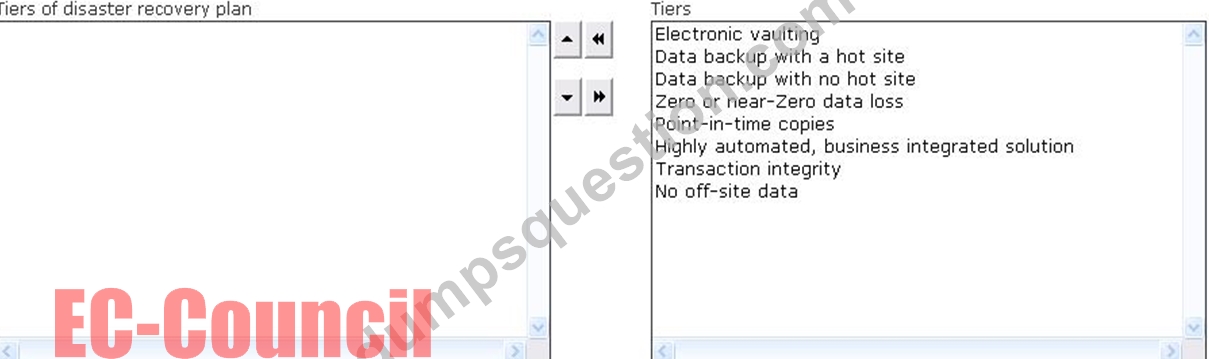
- A.
Answer: A
NEW QUESTION # 51
Oliver's team had been working hard on a proposal for a new project. After meticulously working out the details for a month, they found out that someone had leaked their proposal to their competitor and they had lost the project. This impacted their morale hugely, and for the next two months, all the other projects progressed extremely slowly resulting in their delay. Which of the following best describes the impact that this data breach had on the organization?
- A. Qualitative Impact
- B. Semi-Qualitative Impact
- C. Quantitative Impact
- D. Industrial Impact
Answer: A
Explanation:
Qualitative Impact assesses non-measurable effects, such as morale, productivity, and reputation, which align with the scenario's focus on slowed progress and team morale.
* Option A (Semi-Qualitative):A hybrid term, less precise here.
* Option C (Quantitative):Measurable losses (e.g., financial), not the primary focus.
* Option D (Industrial):Too broad, not specific to impact type.
* "Qualitative Impact evaluates intangible consequences like morale and operational delays following a breach, critical for BIA" (Module: Business Impact Analysis, Section: Impact Types).
NEW QUESTION # 52
You are responsible for network and information security at a large hospital. It is a significant concern that any change to any patient record can be easily traced back to the person who made that change. What is this called?
- A. Data Protection
- B. Confidentiality
- C. Non repudiation
- D. Availability
Answer: C
NEW QUESTION # 53
Cameron wanted to back up the data present on his organization's server in case a disaster struck and the data was lost. The software he used created a copy of the data using block-level imaging. Which software did Cameron use?
- A. Bare-metal Restore
- B. Cloud Backup
- C. Visualization
- D. Disk Imaging
Answer: D
Explanation:
Disk Imaging software creates a block-level copy of an entire disk or partition, capturing all data, including the OS and applications, for restoration. This fits Cameron's need for a comprehensive server backup.
* Option A (Cloud Backup):Typically file-based, not block-level imaging.
* Option C (Visualization):Likely a typo for "Virtualization," which isn't backup software.
* Option D (Bare-metal Restore):A recovery process, not the software creating the image.
* EDRP v3 discusses disk imaging as a key backup method for complete system recovery (Module: Data Backup and Recovery).
NEW QUESTION # 54
Which of the following statements best describes the difference between the role of a data owner and the role of a data custodian?
- A. The data custodian implements the information classification scheme after the initial assignment by the data owner.
- B. The data owner implements the information classification scheme after the initial assignment by the custodian.
- C. The custodian makes the initial information classification assignments and the operations manager implements the scheme.
- D. The custodian implements the information classification scheme after the initial assignment by the operations manager.
Answer: A
NEW QUESTION # 55
You are the project manager for a construction project. The project involves casting of a column in a very narrow space. Because of the lack of space, casting is highly dangerous. High technical skill will be required for casting that column. You decide to hire a local expert team for casting that column. Which of the following types of risk response are you following?
- A. Transference
- B. Avoidance
- C. Acceptance
- D. Mitigation
Answer: A
NEW QUESTION # 56
Which of the following processes helps the organization to identify appropriate controls for reducing or eliminating risk during the risk mitigation process?
- A. Risk Assessment
- B. Risk Acceptance
- C. Risk Transference
- D. Risk Identification
Answer: A
NEW QUESTION # 57
Which of the following classification schemes is considered to be of a personal nature and is intended for company use only?
- A. Public information
- B. Sensitive information
- C. Confidential information
- D. Private information
Answer: D
NEW QUESTION # 58
Jon wanted to conduct a vulnerability assessment for his startup in order to safeguard it from any disaster in the future. The steps in vulnerability assessment are given below:
a) Assess the potential impact of the threat on the organization
b) Estimate the probability of occurrence of each threat
c) Assess the internal and external resources available to mitigate the identified threats d) List the threats that may occur In which order should Jon implement these steps?
- A. b, c, d, a
- B. d, b, a, c
- C. c, a, d, b
- D. b, d, c, a
Answer: B
Explanation:
A vulnerability assessment follows a logical sequence:
* d) List the threats that may occur- Identify potential threats first.
* b) Estimate the probability of occurrence of each threat- Assess likelihood next.
* a) Assess the potential impact of the threat on the organization- Evaluate impact after probability.
* c) Assess the internal and external resources available to mitigate the identified threats- Finally, review mitigation resources.This order (d, b, a, c) ensures threats are identified before analyzing their likelihood, impact, and mitigation, aligning with standard risk assessment practices.
* Option A (c, a, d, b):Starts with resources, illogical without threats.
* Option C (b, d, c, a):Probability before listing threats is premature.
* Option D (b, c, d, a):Probability and resources before threats is out of sequence.
* "Vulnerability assessment begins with listing threats, followed by estimating probability, assessing impact, and evaluating mitigation resources in that order (d, b, a, c)" (Module: Risk Management, Section: Vulnerability Assessment Steps).
NEW QUESTION # 59
After learning about the features of PASIS architecture, James decides to implement the same in his startup.
After a few months, an earthquake destroyed a few storage nodes in the central server rendering the data in those nodes unreadable. Since James had implemented the PASIS architecture, he was able to recover the data present in the destroyed nodes. Which feature of PASIS architecture allowed James to recover the data?
- A. Availability
- B. Reaction
- C. Integrity
- D. Durability
Answer: D
Explanation:
Durability in PASIS (Pittsburgh Advanced Survivable Information Storage) ensures data remains recoverable despite node failures, using redundancy and encoding, enabling James to retrieve data post-earthquake.
* Option B (Availability):Ensures access, not recovery after loss.
* Option C (Reaction):Not a PASIS feature.
* Option D (Integrity):Ensures data accuracy, not recovery.
* "Durability in PASIS architecture guarantees data recovery from failed nodes through redundancy and encoding, enhancing survivability" (Module: Survivable Storage Systems, Section: PASIS Features).
NEW QUESTION # 60
Which of the following techniques verifies that data is safe, secure, and readable after going through processes like update, restore, or retrieve?
- A. Backup Integrity Testing
- B. Database Consolidation
- C. Database Integrity Testing
- D. Database Authentication
Answer: A
Explanation:
Backup Integrity Testing is the process of verifying that backed-up data remains safe, secure, andreadable after operations such as updates, restores, or retrievals. This involves checking for corruption, ensuring data consistency, and confirming that the backup can be successfully restored. In disaster recovery, this is a critical step to ensure that backups are reliable when needed.
* Option A (Database Authentication):Refers to verifying user access, not data integrity.
* Option B (Database Consolidation):Involves merging databases, not testing backup integrity.
* Option C (Database Integrity Testing):Focuses on database consistency, not specifically backup verification.
* "Backup Integrity Testing ensures that data backups remain uncorrupted and usable post-operation.
This process includes validation checks after updates or restores to guarantee recoverability, a key component of data protection strategies" (Module: Data Backup and Recovery, Section: Backup Validation Techniques).
NEW QUESTION # 61
Which disaster recovery plan is very expensive and disrupts normal business operations?
- A. Parallel Testing
- B. Checklist Testing
- C. Simulation Testing
- D. Full Interruption Testing
Answer: D
Explanation:
Full Interruption Testing involves shutting down primary systems to test recovery processes, making it expensive (due to downtime costs) and disruptive to normal operations.
* Option B (Simulation Testing):Mimics a disaster without stopping operations.
* Option C (Parallel Testing):Runs recovery systems alongside primary ones, non-disruptive.
* Option D (Checklist Testing):A review process, no operational impact.
* "Full Interruption Testing, while thorough, incurs high costs and disrupts business by halting primary systems to validate recovery" (Module: Testing Disaster Recovery Plans, Section: Test Types).
NEW QUESTION # 62
Which of the following terms refers to the delay experienced by a system while it is serving a request?
- A. Durability
- B. Nonrepudiation
- C. Reaction
- D. Latency
Answer: D
Explanation:
Latency is the time delay between a request and the system's response, directly matching the question's description.
* Option A (Reaction):Not a technical term for delay.
* Option B (Durability):Refers to data persistence, not response time.
* Option C (Nonrepudiation):Ensures actions can't be denied, unrelated to delay.
* "Latency measures the delay in system response to requests, a critical factor in assessing recovery and performance" (Module: System Resilience, Section: Performance Metrics).
NEW QUESTION # 63
Which of the following concepts represent the three fundamental principles of information security?
Each correct answer represents a complete solution. Choose three.
- A. Availability
- B. Confidentiality
- C. Integrity
- D. Privacy
Answer: A,B,C
NEW QUESTION # 64
......
Get Instant Access to 312-76 Practice Exam Questions: https://examsdocs.dumpsquestion.com/312-76-exam-dumps-collection.html