

Updated Jul-2026 Exam SY0-701 Dumps - Pass Your Certification Exam
Latest Real CompTIA SY0-701 Exam Dumps Questions
CompTIA SY0-701 Exam Syllabus Topics:
| Topic | Details |
|---|---|
| Topic 1 |
|
| Topic 2 |
|
| Topic 3 |
|
| Topic 4 |
|
| Topic 5 |
|
NEW QUESTION # 246
A security administrator recently reset local passwords and the following values were recorded in the system: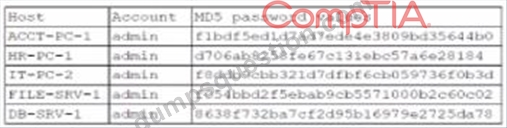
Which of the following in the security administrator most likely protecting against?
- A. Account sharing
- B. Password compromise
- C. Weak password complexity
- D. Pass-the-hash attacks
Answer: D
Explanation:
The scenario shows MD5 hashed password values. The most likely reason the security administrator is focusing on these values is to protect against pass-the-hash attacks. In this type of attack, an attacker can use a captured hash to authenticate without needing to know the actual plaintext password. By managing and monitoring these hashes, the administrator can implement strategies to mitigate this type of threat.
Reference =
CompTIA Security+ SY0-701 Course Content: Domain 04 Security Operations.
CompTIA Security+ SY0-601 Study Guide: Chapter on Identity and Access Management.
NEW QUESTION # 247
A systems administrator is looking for a low-cost application-hosting solution that is cloud-based. Which of the following meets these requirements?
- A. SD-WAN
- B. Serverless framework
- C. SDN
- D. Type 1 hvpervisor
Answer: B
Explanation:
Explanation
A serverless framework is a cloud-based application-hosting solution that meets the requirements of low-cost and cloud-based. A serverless framework is a type of cloud computing service that allows developers to run applications without managing or provisioning any servers. The cloud provider handles the server-side infrastructure, such as scaling, load balancing, security, and maintenance, and charges the developer only for the resources consumed by the application. A serverless framework enables developers to focus on the application logic and functionality, and reduces the operational costs and complexity of hosting applications.
Some examples of serverless frameworks are AWS Lambda, Azure Functions, and Google Cloud Functions.
A type 1 hypervisor, SD-WAN, and SDN are not cloud-based application-hosting solutions that meet the requirements of low-cost and cloud-based. A type 1 hypervisor is a software layer that runs directly on the hardware and creates multiple virtual machines that can run different operating systems and applications. A type 1 hypervisor is not a cloud-based service, but a virtualization technology that can be used to create private or hybrid clouds. A type 1 hypervisor also requires the developer to manage and provision the servers and the virtual machines, which can increase the operational costs and complexity of hosting applications. Some examples of type 1 hypervisors are VMware ESXi, Microsoft Hyper-V, and Citrix XenServer.
SD-WAN (Software-Defined Wide Area Network) is a network architecture that uses software to dynamically route traffic across multiple WAN connections, such as broadband, LTE, or MPLS. SD-WAN is not a cloud-based service, but a network optimization technology that can improve the performance, reliability, and security of WAN connections. SD-WAN can be used to connect remote sites or users to cloud-based applications, but it does not host the applications itself. Some examples of SD-WAN vendors are Cisco, VMware, and Fortinet.
SDN (Software-Defined Networking) is a network architecture that decouples the control plane from the data plane, and uses a centralized controller to programmatically manage and configure the network devices and traffic flows. SDN is not a cloud-based service, but a network automation technology that can enhance the scalability, flexibility, and efficiency of the network. SDN can be used to create virtual networks or network functions that can support cloud-based applications, but it does not host the applications itself. Some examples of SDN vendors are OpenFlow, OpenDaylight, and OpenStack.
References = CompTIA Security+ SY0-701 Certification Study Guide, page 264-265; Professor Messer's CompTIA SY0-701 Security+ Training Course, video 3.1 - Cloud and Virtualization, 7:40 - 10:00; [Serverless Framework]; [Type 1 Hypervisor]; [SD-WAN]; [SDN].
NEW QUESTION # 248
A user is attempting to patch a critical system, but the patch fails to transfer. Which of the following access controls is most likely inhibiting the transfer?
- A. Attribute-based
- B. Least privilege
- C. Role-based
- D. Time of day
Answer: B
Explanation:
The least privilege principle states that users and processes should only have the minimum level of access required to perform their tasks. This helps to prevent unauthorized or unnecessary actions that could compromise security. In this case, the patch transfer might be failing because the user or process does not have the appropriate permissions to access the critical system or the network resources needed for the transfer. Applying the least privilege principle can help to avoid this issue by granting the user or process the necessary access rights for the patching activity. References: CompTIA Security+ Study Guide: Exam SY0-
701, 9th Edition, page 931
NEW QUESTION # 249
A company decided to reduce the cost of its annual cyber insurance policy by removing the coverage for ransomware attacks.
Which of the following analysis elements did the company most likely use in making this decision?
- A. ARO
- B. RTO
- C. MTBF
- D. IMTTR
Answer: A
Explanation:
ARO (Annualized Rate of Occurrence) is an analysis element that measures the frequency or likelihood of an event happening in a given year. ARO is often used in risk assessment and management, as it helps to estimate the potential loss or impact of an event. A company can use ARO to calculate the annualized loss expectancy (ALE) of an event, which is the product of ARO and the single loss expectancy (SLE). ALE represents the expected cost of an event per year, and can be used to compare with the cost of implementing a security control or purchasing an insurance policy.
The company most likely used ARO in making the decision to remove the coverage for ransomware attacks from its cyber insurance policy. The company may have estimated the ARO of ransomware attacks based on historical data, industry trends, or threat intelligence, and found that the ARO was low or negligible. The company may have also calculated the ALE of ransomware attacks, and found that the ALE was lower than the cost of the insurance policy. Therefore, the company decided to reduce the cost of its annual cyber insurance policy by removing the coverage for ransomware attacks, as it deemed the risk to be acceptable or manageable.
IMTTR (Incident Management Team Training and Readiness), RTO (Recovery Time Objective), and MTBF (Mean Time Between Failures) are not analysis elements that the company most likely used in making the decision to remove the coverage for ransomware attacks from its cyber insurance policy. IMTTR is a process of preparing and training the incident management team to respond effectively to security incidents. IMTTR does not measure the frequency or impact of an event, but rather the capability and readiness of the team. RTO is a metric that defines the maximum acceptable time for restoring a system or service after a disruption. RTO does not measure the frequency or impact of an event, but rather the availability and continuity of the system or service. MTBF is a metric that measures the average time between failures of a system or component. MTBF does not measure the frequency or impact of an event, but rather the reliability and performance of the system or component.
Reference = CompTIA Security+ SY0-701 Certification Study Guide, page 97-98; Professor Messer's CompTIA SY0-701 Security+ Training Course, video 5.2 - Risk Management, 0:00 - 3:00.
NEW QUESTION # 250
A network manager wants to protect the company's VPN by implementing multifactor authentication that uses:
. Something you know
. Something you have
. Something you are
Which of the following would accomplish the manager's goal?
- A. Company URL, TLS certificate, home address
- B. VPN IP address, company ID, facial structure
- C. Password, authentication token, thumbprint
- D. Domain name, PKI, GeolP lookup
Answer: C
Explanation:
The correct answer is C. Password, authentication token, thumbprint. This combination of authentication factors satisfies the manager's goal of implementing multifactor authentication that uses something you know, something you have, and something you are.
Something you know is a type of authentication factor that relies on the user's knowledge of a secret or personal information, such as a password, a PIN, or a security question. A password is a common example of something you know that can be used to access a VPN12 Something you have is a type of authentication factor that relies on the user's possession of a physical object or device, such as a smart card, a token, or a smartphone. An authentication token is a common example of something you have that can be used to generate a one-time password (OTP) or a code that can be used to access a VPN12 Something you are is a type of authentication factor that relies on the user's biometric characteristics, such as a fingerprint, a face, or an iris. A thumbprint is a common example of something you are that can be used to scan and verify the user's identity to access a VPN12 Reference:
1: CompTIA Security+ Study Guide: Exam SY0-701, 9th Edition, Chapter 4: Identity and Access Management, page 177 2: CompTIA Security+ Certification Kit: Exam SY0-701, 7th Edition, Chapter 4: Identity and Access Management, page 179
NEW QUESTION # 251
A security analyst notices an increase in port scans on the edge of the corporate network. Which of the following logs should the analyst check to obtain the attacker's source IP address?
- A. OS security
- B. Endpoint
- C. Firewall
- D. Application
Answer: C
Explanation:
A firewall log records inbound and outbound network traffic, including source and destination IP addresses, port numbers, and connection attempts. Since port scans involve probing various ports on a network, the firewall logs will provide visibility into the attacker's source IP address and help the analyst assess the nature of the scanning activity.
NEW QUESTION # 252
A company is developing a business continuity strategy and needs to determine how many staff members would be required to sustain the business in the case of a disruption. Which of the following best describes this step?
- A. Geographic dispersion
- B. Redundancy
- C. Tablet exercise
- D. Capacity planning
Answer: D
Explanation:
Capacity planning is the process of determining the resources needed to meet the current and future demands of an organization. Capacity planning can help a company develop a business continuity strategy by estimating how many staff members would be required to sustain the business in the case of a disruption, such as a natural disaster, a cyberattack, or a pandemic. Capacity planning can also help a company optimize the use of its resources, reduce costs, and improve performance. References = CompTIA Security+ Study Guide with over 500 Practice Test Questions: Exam SY0-701, 9th Edition, Chapter 4, page 184. CompTIA Security+ (SY0-701) Certification Exam Objectives, Domain 4.1, page 14. Business Continuity - SY0-601 CompTIA Security+ : 4.1
NEW QUESTION # 253
A company that is located in an area prone to hurricanes is developing a disaster recovery plan and looking at site considerations that allow the company to immediately continue operations.
Which of the following is the best type of site for this company?
- A. Hot
- B. Tertiary
- C. Cold
- D. Warm
Answer: A
Explanation:
For a company located in an area prone to hurricanes and needing to immediately continue operations, the best type of site is a hot site. A hot site is a fully operational offsite data center that is equipped with hardware, software, and network connectivity and is ready to take over operations with minimal downtime.
Hot site: Fully operational and can take over business operations almost immediately after a disaster.
Cold site: A basic site with infrastructure in place but without hardware or data, requiring significant time to become operational.
Tertiary site: Not a standard term in disaster recovery; it usually refers to an additional backup location but lacks the specifics of readiness.
Warm site: Equipped with hardware and connectivity but requires some time and effort to become fully operational, not as immediate as a hot site.
NEW QUESTION # 254
Which of the following should a security administrator adhere to when setting up a new set of firewall rules?
- A. Disaster recovery plan
- B. Incident response procedure
- C. Change management procedure
- D. Business continuity plan
Answer: C
Explanation:
Explanation
A change management procedure is a set of steps and guidelines that a security administrator should adhere to when setting up a new set of firewall rules. A firewall is a device or software that can filter, block, or allow network traffic based on predefined rules or policies. A firewall rule is a statement that defines the criteria and action for a firewall to apply to a packet or a connection. For example, a firewall rule can allow or deny traffic based on the source and destination IP addresses, ports, protocols, or applications. Setting up a new set of firewall rules is a type of change that can affect the security, performance, and functionality of the network.
Therefore, a change management procedure is necessary to ensure that the change is planned, tested, approved, implemented, documented, and reviewed in a controlled and consistent manner. A change management procedure typically includes the following elements:
A change request that describes the purpose, scope, impact, and benefits of the change, as well as the roles and responsibilities of the change owner, implementer, and approver.
A change assessment that evaluates the feasibility, risks, costs, and dependencies of the change, as well as the alternatives and contingency plans.
A change approval that authorizes the change to proceed to the implementation stage, based on the criteria and thresholds defined by the change policy.
A change implementation that executes the change according to the plan and schedule, and verifies the results and outcomes of the change.
A change documentation that records the details and status of the change, as well as the lessons learned and best practices.
A change review that monitors and measures the performance and effectiveness of the change, and identifies any issues or gaps that need to be addressed or improved.
A change management procedure is important for a security administrator to adhere to when setting up a new set of firewall rules, as it can help to achieve the following objectives:
Enhance the security posture and compliance of the network by ensuring that the firewall rules are aligned with the security policies and standards, and that they do not introduce any vulnerabilities or conflicts.
Minimize the disruption and downtime of the network by ensuring that the firewall rules are tested and validated before deployment, and that they do not affect the availability or functionality of the network services or applications.
Improve the efficiency and quality of the network by ensuring that the firewall rules are optimized and updated according to the changing needs and demands of the network users and stakeholders, and that they do not cause any performance or compatibility issues.
Increase the accountability and transparency of the network by ensuring that the firewall rules are documented and reviewed regularly, and that they are traceable and auditable by the relevant authorities and parties.
The other options are not correct because they are not related to the process of setting up a new set of firewall rules. A disaster recovery plan is a set of policies and procedures that aim to restore the normal operations of an organization in the event of a system failure, natural disaster, or other emergency. An incident response procedure is a set of steps and guidelines that aim to contain, analyze, eradicate, and recover from a security incident, such as a cyberattack, data breach, or malware infection. A business continuity plan is a set of strategies and actions that aim to maintain the essential functions and operations of an organization during and after a disruptive event, such as a pandemic, power outage, or civil unrest. References = CompTIA Security+ Study Guide (SY0-701), Chapter 7: Resilience and Recovery, page 325. Professor Messer's CompTIA SY0-701 Security+ Training Course, Section 1.3: Security Operations, video: Change Management (5:45).
NEW QUESTION # 255
Which of the following receives logs from various devices and services, and then presents alerts?
- A. SNMP
- B. SIEM
- C. SCADA
- D. SCAP
Answer: B
Explanation:
A SIEM (Security Information and Event Management) system aggregates logs from diverse sources, analyzes them, and generates alerts on suspicious activities. It provides centralized monitoring and incident detection.
SCADA (B) is industrial control, SNMP (C) is a protocol for network management, and SCAP (D) is a standard for security content automation.
SIEMs are foundational in Security Operations monitoring#6:Chapter 14 CompTIA Security+ Study Guide#.
NEW QUESTION # 256
Which of the following makes Infrastructure as Code (IaC) a preferred security architecture over traditional infrastructure models?
- A. Configuration can be better managed and replicated.
- B. Optimization can occur across a number of computing instances.
- C. Outsourcing to a third party with more expertise in network defense is possible.
- D. Common attacks are less likely to be effective.
Answer: A
Explanation:
Infrastructure as Code (IaC) enables automated provisioning and configuration of infrastructure, making environments repeatable, consistent, and scalable. The ability to better manage and replicate configurations ensures that security settings are not missed and reduces misconfigurations.
NEW QUESTION # 257
Which of the following is a social engineering attack in which a bad actor impersonates a web URL?
- A. Watering-hole
- B. Misinformation
- C. Pretexting
- D. Typosquatting
Answer: D
Explanation:
Typosquatting is a social engineering and cybersquatting technique in which attackers register domain names similar to legitimate ones, hoping users will make a typographical error and visit their malicious website instead.
Reference:
CompTIA Security+ SY0-701 Official Study Guide, Domain 2.2: "Typosquatting involves registering misspelled versions of legitimate domain names to trick users." Exam Objectives 2.2: "Given a scenario, analyze potential indicators associated with application attacks."
NEW QUESTION # 258
A security administrator is hardening corporate systems and applying appropriate mitigations by consulting a real-world knowledge base for adversary behavior. Which of the following would be best for the administrator to reference?
- A. CSIRT
- B. SOAR
- C. CVSS
- D. MITRE ATT&CK
Answer: D
Explanation:
MITRE ATT&CK is a comprehensive and widely used framework that categorizes and describes the various tactics, techniques and procedures (TTPs) employed by adversaries, it is used for threat intelligence, defensive strategy etc.
NEW QUESTION # 259
An organization would like to calculate the time needed to resolve a hardware issue with a server.
Which of the following risk management processes describes this example?
- A. Mean time to repair
- B. Recovery time objective
- C. Recovery point objective
- D. Mean time between failures
Answer: A
Explanation:
Mean time to repair (MTTR) describes the time needed to resolve a hardware issue with a server.
MTTR is a key metric in risk management and maintenance that measures the average time required to repair a failed component or system and restore it to operational status.
Recovery point objective (RPO): Defines the maximum acceptable amount of data loss measured in time. It is the point in time to which data must be restored after a disaster.
Mean time between failures (MTBF): Measures the average time between failures of a system or component, indicating reliability.
Recovery time objective (RTO): Defines the maximum acceptable length of time to restore a system after a disaster or disruption.
Mean time to repair (MTTR): Measures the average time required to repair a failed component or system.
NEW QUESTION # 260
A company prevented direct access from the database administrators' workstations to the network segment that contains database servers. Which of the following should a database administrator use to access the database servers?
- A. Load balancer
- B. Jump server
- C. HSM
- D. RADIUS
Answer: B
Explanation:
A jump server is a device or virtual machine that acts as an intermediary between a user's workstation and a remote network segment. A jump server can be used to securely access servers or devices that are not directly reachable from the user's workstation, such as database servers. A jump server can also provide audit logs and access control for the remote connections. A jump server is also known as a jump box or a jump host12.
RADIUS is a protocol for authentication, authorization, and accounting of network access. RADIUS is not a device or a method to access remote servers, but rather a way to verify the identity and permissions of users or devices that request network access34.
HSM is an acronym for Hardware Security Module, which is a physical device that provides secure storage and generation of cryptographic keys. HSMs are used to protect sensitive data and applications, such as digital signatures, encryption, and authentication. HSMs are not used to access remote servers, but rather to enhance the security of the data and applications that reside on them5 .
A load balancer is a device or software that distributes network traffic across multiple servers or devices, based on criteria such as availability, performance, or capacity. A loadbalancer can improve the scalability, reliability, and efficiency of network services, such as web servers, application servers, or database servers. A load balancer is not used to access remote servers, but rather to optimize the delivery of the services that run on them . References = How to access a remote server using a jump host Jump server RADIUS Remote Authentication Dial-In User Service (RADIUS) Hardware Security Module (HSM)
[What is an HSM?]
[Load balancing (computing)]
[What is Load Balancing?]
NEW QUESTION # 261
......
SY0-701 Dumps To Pass CompTIA Security+ Exam in One Day: https://examsdocs.dumpsquestion.com/SY0-701-exam-dumps-collection.html