

Latest Python Institute PCPP-32-101 Practice Test Questions, PCPP1 - Certified Professional in Python Programming 1 Exam Dumps
May-2025 Pass Python Institute PCPP-32-101 Exam in First Attempt Easily
The PCPP1 certification exam is an essential credential for anyone seeking to demonstrate their proficiency in Python programming. It tests the fundamental knowledge and skills required for professional-level Python programming and provides a valuable credential that can help professionals advance their careers. PCPP-32-101 exam is available in several languages and can be taken at any Pearson VUE testing center around the world.
Python Institute PCPP1 certification is a globally recognized credential that validates a candidate's proficiency in Python programming. It is an ideal certification for developers, software engineers, data analysts, and anyone who works with Python programming. By obtaining the PCPP1 certification, candidates can demonstrate their commitment to professional development, enhance their job prospects, and increase their earning potential. PCPP1 - Certified Professional in Python Programming 1 certification is valid for five years and can be renewed by passing the PCPP1-2019 exam.
NEW QUESTION # 12
The following snippet represents one of the OOP pillars Which one is that?
- A. Serialization
- B. Polymorphism
- C. Encapsulation
- D. Inheritance
Answer: C
Explanation:
Explanation
The given code snippet demonstrates the concept of encapsulation in object-oriented programming.
Encapsulation refers to the practice of keeping the internal state and behavior of an object hidden from the outside world and providing a public interface for interacting with the object. In the given code snippet, the __init__ and get_balance methods provide a public interface for interacting with instances of the BankAccount class, while the __balance attribute is kept hidden from the outside world by using a double underscore prefix.
NEW QUESTION # 13
Analyze the following snippet and choose the best statement that describes it.
- A. self. name is the name of a class variable.
- B. varl is the name of a global variable
- C. Excalibur is the value passed to an instance variable
- D. Weapon is the value passed to an instance variable
Answer: C
Explanation:
Explanation
The correct answer is C. Excalibur is the value passed to an instance variable. In the given code snippet, self.name is an instance variable of the Sword class. When an instance of the Sword class is created with varl = Sword('Excalibur'), the value 'Excalibur' is passed as an argument to the __init__ method and assigned to the name instance variable of the varl object.
The code defines a class called Sword with an __init__ method that takes one parameter name. When a new instance of the Sword class is created with varl = Sword('Excalibur'), the value of the 'Excalibur' string is passed as an argument to the __init__ method, and assigned to the self.name instance variable of the varl object.
NEW QUESTION # 14
What does the term deserialization mean? Select the best answer.
- A. It is a process of assigning unique identifiers to every newly created Python object
- B. It is another name for the data transmission process
- C. It is a process of converting the structure of an object into a stream of bytes
- D. It is a process of creating Python objects based on sequences of bytes.
Answer: D
Explanation:
Explanation
answer A. Deserialization is the process of converting data that has been serialized or encoded in a specific format, back into its original form as an object or a data structure in memory. In Python, this typically involves creating Python objects based on sequences of bytes that have been serialized using a protocol such as JSON, Pickle, or YAML.
For example, if you have a Python object my_obj and you want to serialize it to a JSON string, you might do something like this:
importjson
serialized_obj = json.dumps(my_obj)
To deserialize the JSON string back into a Python object, you would use the json.loads() method:
deserialized_obj = json.loads(serialized_obj)
This would convert the JSON string back into its original Python object form.
NEW QUESTION # 15
Select the true statement about the___name___attribute.
- A. __name___is a special attribute, which is inherent for classes, and it contains the name of a class.
- B. __name___is a special attribute, which is inherent for classes and it contains information about the class to which a class instance belongs.
- C. ___name is a special attribute, which is inherent for both classes and instances, and it contains a dictionary of object attributes.
- D. ___name___is a special attribute, which is inherent for both classes and instances, and it contains information about the class to which a class instance belongs.
Answer: A
Explanation:
Explanation
The true statement about the __name__ attribute is D. name is a special attribute, which is inherent for classes, and it contains the name of a class. The __name__ attribute is a special attribute of classes that contains the name of the class as a string.
The __name__ attribute is a special attribute in Python that is available for all classes, and it contains the name of the class as a string. The __name__ attribute can be accessed from both the class and its instances using the dot notation.
NEW QUESTION # 16
What is true about the unbind () method? (Select two answers.)
- A. It needs a widget's object as an argument
- B. It is invoked from within the events object
- C. It is invoked from within a widget's object
- D. It needs the event name as an argument
Answer: C,D
Explanation:
Explanation
Option B is true because the unbind() method is invoked from within a widget's object 1.
Option D is true because the unbind() method needs the event name as an argument 1.
The unbind() method in Tkinter is used to remove a binding between an event and a function. It can be invoked from within a widget's object when a binding is no longer needed. The method requires the event name as an argument to remove the binding for that specific event. For example:
button = tk.Button(root, text="Click me")
button.bind("<Button-1>", callback_function) # bind left mouse click event to callback_function button.unbind("<Button-1>") # remove the binding for the left mouse click event
NEW QUESTION # 17
What will happen if the mamwindow is too small to fit all its widgets?
- A. The window will be expanded.
- B. The widgets will be scaled down to fit the window's size.
- C. An exception will be raised.
- D. Some widgets may be invisible
Answer: D
Explanation:
Explanation
If the main window is too small to fit all its widgets, some widgets may be invisible. So, the correct answer is Option A.
When a window is not large enough to display all of its content, some widgets may be partially or completely hidden. The window will not automatically expand to fit all of its content, and no exception will be raised. The widgets will not be automatically scaled down to fit the window's size.
If the main window is too small to fit all its widgets, some of the widgets may not be visible or may be partially visible. This is because the main window has a fixed size, and if there are more widgets than can fit within that size, some of them will be outside the visible area of the window.
To avoid this issue, you can use layout managers such as grid, pack, or place to dynamically adjust the size and position of the widgets as the window changes size. This will ensure that all the widgets remain visible and properly arranged regardless of the size of the main window.
References:
* https://www.tkdocs.com/tutorial/widgets.html#managers
* https://www.geeksforgeeks.org/python-tkinter-widgets/
* https://anzeljg.github.io/rin2/book2/2405/docs/tkinter/introduction.html
NEW QUESTION # 18
What is true about the unbind_all () method?
(Select two answers.)
- A. It can be invoked from the main window widget only
- B. It causes all the widgets to disappear
- C. It is parameterless
- D. It can be invoked from any widget
Answer: C,D
Explanation:
Explanation
The unbind_all() method in Tkinter is used to remove all event bindings from a widget. It is a method of the widget object and can be called on any widget in the Tkinter application. Therefore, option A is the correct answer.
Option B is incorrect because the method can be called on any widget, not just the main window widget.
Option C is correct as unbind_all() does not take any parameters.
Option D is incorrect because the method only removes event bindings and does not cause the widgets to disappear.
So, the correct answers are A and C.
References:
* Tkinter documentation: https://docs.python.org/3/library/tkinter.html#event-bindings
* Tkinter tutorial: https://www.python-course.eu/tkinter_events_binds.php
NEW QUESTION # 19
What isa___traceback___?
(Select two answers )
- A. A special method delivered by the traceback module to retrieve a full list of strings describing thetraceback
- B. An attribute owned by every exception object
- C. An attribute that is added to every object when the traceback module is imported
- D. An attribute that holds interesting information that is particularly useful when the programmer wants to store exception details in other objects
Answer: B,D
Explanation:
Explanation
The correct answers are A. An attribute owned by every exception object and D. An attribute that holds interesting information that is particularly useful when the programmer wants to store exception details in other objects. A traceback is an attribute of an exception object that contains a stack trace representing the call stack at the point where the exception was raised. The traceback attribute holds information about the sequence of function calls that led to the exception, which can be useful for debugging and error reporting.
NEW QUESTION # 20
What is true about type in the object-oriented programming sense?
- A. It is the bottommost type that any object can inherit from.
- B. It is an object used to instantiate a class
- C. It is a built-in method that allows enumeration of composite objects
- D. It is the topmost type that any class can inherit from
Answer: D
Explanation:
Explanation
In Python, type is the built-in metaclass that serves as the base class for all new-style classes. All new-style classes in Python, including built-in types like int and str, are instances of the type metaclass and inherit from it.
NEW QUESTION # 21
Select the true statements related to PEP 8 programming recommendations for code writing. (Select two answers:)
- A. You should write code in a way that favors the CPython implementation over PyPy, Cython. and Jython.
- B. You should make object type comparisons using the ismstanceQ method (e.g. if isinstance (obj, int) :) instead of comparing types directly (eg if type(obj) is type(i)).
- C. You should not write string literals that rely on significant trailing whitespaces as they may be visually indistinguishable, and certain editors may trim them
- D. You should use the not ... is operator (e.g. if not spam is None:), rather than the is not operator (e.g.if spam is notNone:), to increase readability.
Answer: B,C
Explanation:
Explanation
The two true statements related to PEP 8 programming recommendations for code writing are Option B and Option D.
Option B is true because PEP 8 recommends making object type comparisons using the isinstance() method instead of comparing types directly 1.
Option D is true because PEP 8 recommends not writing string literals that rely on significant trailing whitespaces as they may be visually indistinguishable, and certain editors may trim them 1.
NEW QUESTION # 22
Which of the following methods allow you to load a configuration using ConfigParser? (Select two answers.)
- A. read
- B. read_str
- C. read_conf
- D. read_dict
Answer: A,B
Explanation:
Explanation
ConfigParser is a built-in library in Python that allows you to read and write configuration files. The read method is used to read the configuration file which can be in any of the supported file formats, such as INI, YAML, and JSON. The read_dict method is used to read the configuration from a Python dictionary. The read_conf and read_str options are not valid methods in the ConfigParser module.
Therefore, the correct options to load a configuration using ConfigParser are A. read and D. read_string.
NEW QUESTION # 23
What will be the content of the co/ors.csv filewhen you run the following code?
A)
B)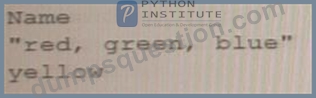
C)
D)
An exception will be raised.
- A. Option A
- B. Option D
- C. Option C
- D. Option B
Answer: D
NEW QUESTION # 24
In the JSON processing context, the term serialization:
- A. names a process in which a JSON string is turned into Python data.
- B. names a process in which a JSON string is remodeled and transformed into a new JSON string
- C. refers to nothing, because there is no such thing as JSON serialization.
- D. names a process in which Python data is turned into a JSON string.
Answer: D
Explanation:
Explanation
In the JSON processing context, the term serialization: A. names a process in which Python data is turned into a JSON string.
Serialization refers to the process of converting a data object, such as a Python object, into a format that can be easily transferred over a network or stored in a file. In the case of JSON, serialization refers to converting Python data into a string representation using the JSON format. This string can be sent over a network or stored as a file, and later deserialized back into the original Python data object.
NEW QUESTION # 25
If w is a correctly created main application window, which method would you use to foe both of the main window's dimensions?
- A. w.makewindow ()
- B. w. f ixshape ()
- C. w. resizable ()
- D. w. f ixdim ()
Answer: C
Explanation:
Explanation
w.resizable()
The resizable() method takes two Boolean arguments, width and height, that specify whether the main window can be resized in the corresponding directions. Passing False to both arguments makes the main window non-resizable, whereas passing True to both arguments (or omitting them) makes the window resizable.
Here is an example that sets the dimensions of the main window to 500x400 pixels and makes it non-resizable:
importtkinter as tk
root = tk.Tk()
root.geometry("500x400")
root.resizable(False, False)
root.mainloop()
References:
* Tkinter documentation: https://docs.python.org/3/library/tk.html
* Tkinter tutorial: https://www.python-course.eu/python_tkinter.php
The resizable () method of a tkinter window object allows you to specify whether the window can be resized by the user in the horizontal and vertical directions. You can pass two boolean arguments to this method, such as w.resizable (False, False), to prevent both dimensions from being changed. Alternatively, you can pass 0 or
1 as arguments, such as w.resizable (0, 0), to achieve the same effect1.
References:
1: https://stackoverflow.com/questions/36575890/how-to-set-a-tkinter-window-to-a-constant-size Other methods that can be used to control the window size are:
* w.geometry () : This method allows you to set the initial size and position of the window by passing a string argument in the format "widthxheight+x+y", such as w.geometry ("500x500+100+100")12.
* w.minsize () and w.maxsize (): These methods allow you to set the minimum and maximum size of the window in pixels, such as w.minsize (500, 500) and w.maxsize (1000, 1000)12.
* w.pack_propagate () and w.grid_propagate (): These methods allow you to enable or disable the propagation of the size of the widgets inside the window to the window itself. By default, these methods are set to True, which means that the window will adjust its size according to the widgets it contains.
You can set these methods to False or 0 to prevent this behavior, such as w.pack_propagate (0) or w.grid_propagate (0).
* w.place (): This method allows you to place the window at a specific position and size relative to its parent window or screen. You can use keyword arguments such as x, y, width, height, relx, rely, relwidth, and relheight to specify the coordinates and dimensions of the window in absolute or relative terms, such as w.place (x=0, y=0, relwidth=1, relheight=1).
References:
2: https://stackoverflow.com/questions/25690423/set-window-dimensions-in-tkinter-python-3 :
https://stackoverflow.com/questions/36575890/how-to-set-a-tkinter-window-to-a-constant-size/36576068#36576
https://www.skotechlearn.com/2020/06/tkinter-window-position-size-center-screen-in-python.html
NEW QUESTION # 26
Select the true statement about composition
- A. Composition extends a class's capabilities by adding new components and modifying the existing ones.
- B. Composition is a concept that promotes code reusability while inheritance promotes encapsulation.
- C. Composition is based on the has a relation: so it cannot be used together with inheritance.
- D. Composition allows a class to be projected as a container of different classes
Answer: D
Explanation:
Explanation
Composition is an object-oriented design concept that models a has-a relationship. In composition, a class known as composite contains an object of another class known as component. In other words, a composite class has a component of another class1.
Composition allows a class to be projected as a container of different classes.
Composition is a concept in Python that allows for building complex objects out of simpler objects, by aggregating one or more objects of another class as attributes. The objects that are aggregated are generally considered to be parts of the whole object, and the containing object is often viewed as a container for the smaller objects.
In composition, objects are combined in a way that allows for greater flexibility and modifiability than what inheritance can offer. With composition, it is possible to create new objects by combining existing objects, by using a container object to host other objects. By contrast, with inheritance, new objects extend the behavior of their parent classes, and are limited by that inheritance hierarchy.
References:
* Official Python documentation on
Composition: https://docs.python.org/3/tutorial/classes.html#composition
* GeeksforGeeks article on Composition vs
Inheritance: https://www.geeksforgeeks.org/composition-vs-inheritance-python/
* Real Python article on Composition and
Inheritance: https://realpython.com/inheritance-composition-python/
NEW QUESTION # 27
Look at the following examples of comments and docstrings in PythonSelect the ones that are useful and compliant with PEP 8 recommendations (Select the two best answers.) A)
- A.
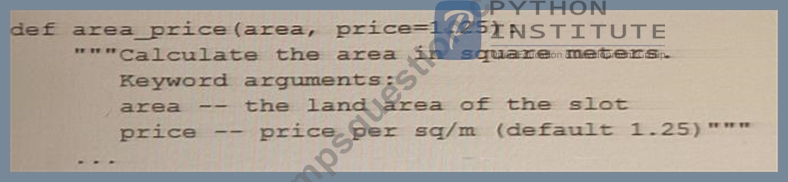
- B.

- C.

- D.

Answer: B,C
Explanation:
Explanation
According to PEP 8 recommendations, the two best options are Option B and Option D.
Option B follows PEP 8's suggestion that all lines should be limited to 79 characters and for longer blocks of text like docstrings or comments, the length should be limited to 72 characters1. Option D follows PEP 8's conventions for writing good documentation strings (a.k.a. "docstrings") which are immortalized in PEP
257. It suggests writing docstrings for all public modules, functions, classes, and methods2.
NEW QUESTION # 28
Which of the following constants will be used if you do riot define the quoting argument in the writer method provided by the csv module?
- A. csv.QUOTE_NONE
- B. svQUOTE_ALL
- C. csv.QUOTE_MINIMAL
- D. csv.QUOTE_NONNUMERIC
Answer: C
Explanation:
Explanation
If you do not define the quoting argument in the writer method provided by the csv module, the default quoting behavior is set to QUOTE_MINIMAL. This means that fields containing special characters such as the delimiter or newline character will be quoted, while fields that do not contain special characters will not be quoted.
NEW QUESTION # 29
Which of the following will set the button text's font to 12 point italics Anal? (Select two answers)
- A.

- B.

- C.

- D.

Answer: A,C
Explanation:
Explanation
Option B is correct because it sets the font option of the button to a tuple containing the font family ('Arial'), size (12), and style ('italic').
Option C is correct because it sets the font option of the button to a string containing the font family ('Arial'), size (12), and style ('italic') separated by spaces.
NEW QUESTION # 30
......
Python Institute PCPP-32-101 (PCPP1 - Certified Professional in Python Programming 1) Certification Exam is a valuable certification program for programmers who want to validate their skills and knowledge in Python programming. PCPP1 - Certified Professional in Python Programming 1 certification demonstrates to employers that the candidate has a solid understanding of Python programming concepts and can write efficient, readable, and maintainable code. PCPP1 - Certified Professional in Python Programming 1 certification also provides a competitive edge in the job market, as it validates the candidate's skills and knowledge in Python programming.
Free PCPP-32-101 Exam Files Downloaded Instantly 100% Dumps & Practice Exam: https://examsdocs.dumpsquestion.com/PCPP-32-101-exam-dumps-collection.html