

2024 Updated DP-300 PDF for the DP-300 Tests Free Updated Today!
Fully Updated Dumps PDF - Latest DP-300 Exam Questions and Answers
The DP-300 exam covers a broad range of topics, including deploying and configuring Azure SQL databases, implementing security, monitoring and troubleshooting database performance, and implementing high availability and disaster recovery solutions. Passing DP-300 exam demonstrates proficiency in administering and maintaining Microsoft Azure SQL databases, providing employers with assurance of an individual's capabilities in managing and maintaining relational databases in a cloud-based environment.
By achieving the DP-300 certification, IT professionals can show that they have the skills and knowledge needed to manage databases on Azure effectively. Administering Relational Databases on Microsoft Azure certification can help to open up new career opportunities and increase earning potential, as companies are always looking for skilled professionals who can manage their data efficiently and securely in the cloud. If you are looking to advance your career in database administration on Azure, the DP-300 certification exam is an excellent place to start.
Microsoft DP-300 exam covers a wide range of topics related to administering relational databases on Azure, including designing and implementing Azure SQL database, securing and auditing data access, monitoring and optimizing database performance, and implementing high availability and disaster recovery solutions. Candidates must have a strong understanding of these topics and be able to apply their knowledge in real-world scenarios.
NEW QUESTION # 97
You have an Azure SQL database named db1 on a server named server1.
The Intelligent Insights diagnostics log identifies queries that cause performance issues due to tempDB contention.
You need to resolve the performance issues.
What should you do?
- A. Implement memory-optimized tables.
- B. Run the dbcc flushprocindB command.
- C. Run the dbcc dbreindex command.
- D. Replace the sequential index keys with nonsequential keys.
Answer: A
Explanation:
Reference:
https://docs.microsoft.com/en-us/azure/azure-sql/database/intelligent-insights-troubleshoot-performance#tempdb
NEW QUESTION # 98
You have an Azure subscription.
You plan to deploy a new Azure virtual machine that will host a Microsoft SQL Server instance.
You need to configure the disks on the virtual machine. The solution must meet the following requirements:
* Minimize latency for transaction logs.
* Minimize the impact on IO Of the virtual machine.
Which type of disk should you use for each workload? To answer. drag the appropriate disk types to the correct workloads. Each disk type may be used once, at all. You may need to drag the split bar between panes or scroll to view content.
NOTE: Each correct selection is worth one point.
Answer:
Explanation:
NEW QUESTION # 99
You have a Microsoft SQL Server database named DB1 that contains a table named Table1.
The database role membership for a user named User1 is shown in the following exhibit.
Use the drop-down menus to select the answer choice that completes each statement based on the information presented in the graphic.
NOTE:Each correct selection is worth one point.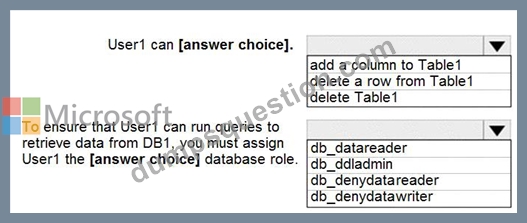
Answer:
Explanation:
Explanation
Box 1: delete a row from Table1
Members of the db_datawriter fixed database role can add, delete, or change data in all user tables.
Box 2: db_datareader
Members of the db_datareader fixed database role can read all data from all user tables.
Reference:
https://docs.microsoft.com/en-us/sql/relational-databases/security/authentication-access/database-level-roles
NEW QUESTION # 100
You are planning the migration of the SERVER1 databases. The solution must meet the business requirements.
What should you include in the migration plan? To answer, select the appropriate options in the answer area.
NOTE: Each correct selection is worth one point.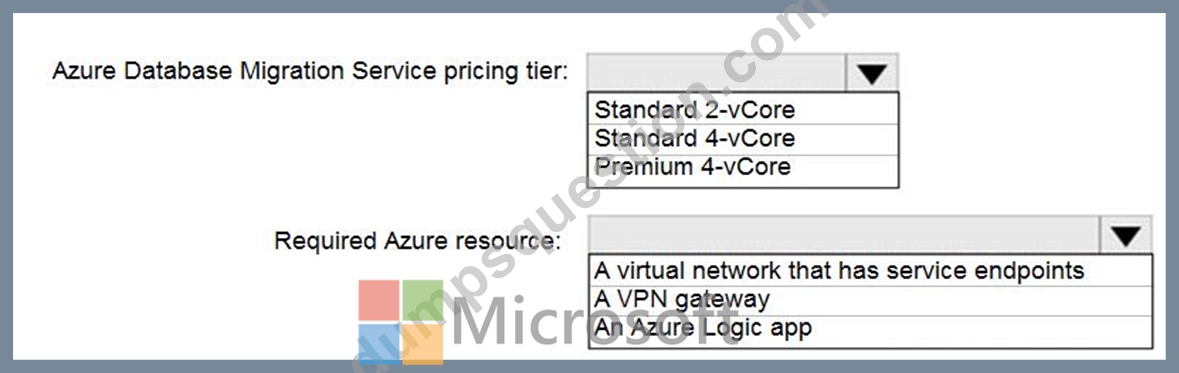
Answer:
Explanation: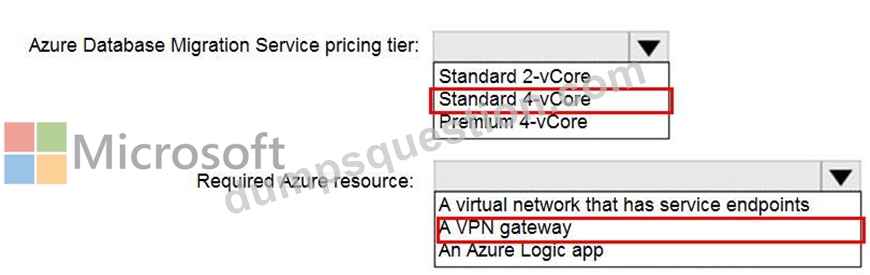
Reference:
https://azure.microsoft.com/pricing/details/database-migration/
https://docs.microsoft.com/en-us/azure/dms/tutorial-sql-server-azure-sql-online
Topic 1, Litware
Existing Environment
Network Environment
The manufacturing and research datacenters connect to the primary datacenter by using a VPN.
The primary datacenter has an ExpressRoute connection that uses both Microsoft peering and private peering. The private peering connects to an Azure virtual network named HubVNet.
Identity Environment
Litware has a hybrid Azure Active Directory (Azure AD) deployment that uses a domain named litwareinc.com. All Azure subscriptions are associated to the litwareinc.com Azure AD tenant.
Database Environment
The sales department has the following database workload:
An on-premises named SERVER1 hosts an instance of Microsoft SQL Server 2012 and two 1-TB databases.
A logical server named SalesSrv01A contains a geo-replicated Azure SQL database named SalesSQLDb1. SalesSQLDb1 is in an elastic pool named SalesSQLDb1Pool. SalesSQLDb1 uses database firewall rules and contained database users.
An application named SalesSQLDb1App1 uses SalesSQLDb1.
The manufacturing office contains two on-premises SQL Server 2016 servers named SERVER2 and SERVER3. The servers are nodes in the same Always On availability group. The availability group contains a database named ManufacturingSQLDb1 Database administrators have two Azure virtual machines in HubVnet named VM1 and VM2 that run Windows Server 2019 and are used to manage all the Azure databases.
Licensing Agreement
Litware is a Microsoft Volume Licensing customer that has License Mobility through Software Assurance.
Current Problems
SalesSQLDb1 experiences performance issues that are likely due to out-of-date statistics and frequent blocking queries.
Requirements
Planned Changes
Litware plans to implement the following changes:
Implement 30 new databases in Azure, which will be used by time-sensitive manufacturing apps that have varying usage patterns. Each database will be approximately 20 GB.
Create a new Azure SQL database named ResearchDB1 on a logical server named ResearchSrv01. ResearchDB1 will contain Personally Identifiable Information (PII) data.
Develop an app named ResearchApp1 that will be used by the research department to populate and access ResearchDB1.
Migrate ManufacturingSQLDb1 to the Azure virtual machine platform.
Migrate the SERVER1 databases to the Azure SQL Database platform.
Technical Requirements
Litware identifies the following technical requirements:
Maintenance tasks must be automated.
The 30 new databases must scale automatically.
The use of an on-premises infrastructure must be minimized.
Azure Hybrid Use Benefits must be leveraged for Azure SQL Database deployments.
All SQL Server and Azure SQL Database metrics related to CPU and storage usage and limits must be analyzed by using Azure built-in functionality.
Security and Compliance Requirements
Litware identifies the following security and compliance requirements:
Store encryption keys in Azure Key Vault.
Retain backups of the PII data for two months.
Encrypt the PII data at rest, in transit, and in use.
Use the principle of least privilege whenever possible.
Authenticate database users by using Active Directory credentials.
Protect Azure SQL Database instances by using database-level firewall rules.
Ensure that all databases hosted in Azure are accessible from VM1 and VM2 without relying on public endpoints.
Business Requirements
Litware identifies the following business requirements:
Meet an SLA of 99.99% availability for all Azure deployments.
Minimize downtime during the migration of the SERVER1 databases.
Use the Azure Hybrid Use Benefits when migrating workloads to Azure.
Once all requirements are met, minimize costs whenever possible.
NEW QUESTION # 101
You plan to deploy an Always On failover cluster instance (FCI) on Azure virtual machines.
You need to provision an Azure Storage account to host a cloud witness for the deployment.
How should you configure the storage account? To answer, select the appropriate options in the answer area.
NOTE: Each correct selection is worth one point.
Answer:
Explanation: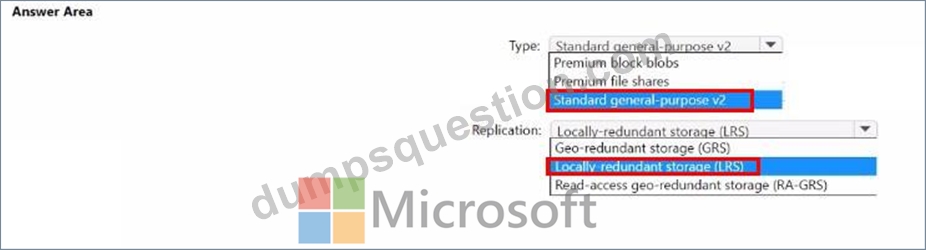
NEW QUESTION # 102
You have an Azure SQL database named DB1 that contains two tables named Table1 and Table2. Both tables contain a column named a Column1. Column1 is used for joins by an application named App1.
You need to protect the contents of Column1 at rest, in transit, and in use.
How should you protect the contents of Column1? To answer, select the appropriate options in the answer area.
NOTE:Each correct selection is worth one point.
Answer:
Explanation:
Explanation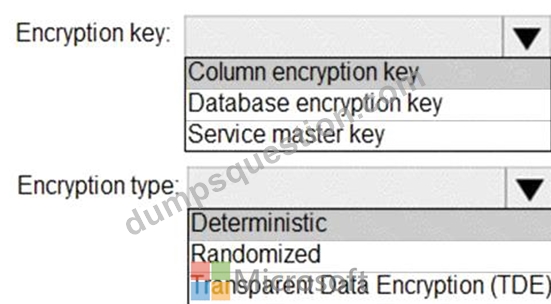
Box 1: Column encryption Key
Always Encrypted uses two types of keys: column encryption keys and column master keys. A column encryption key is used to encrypt data in an encrypted column. A column master key is a key-protecting key that encrypts one or more column encryption keys.
Reference:
https://docs.microsoft.com/en-us/sql/relational-databases/security/encryption/always-encrypted-database-engine
NEW QUESTION # 103
HOTSPOT
You have SQL Server on an Azure virtual machine that contains a database named DB1.
The database reports a CHECKSUM error.
You need to recover the database.
How should you complete the statements? To answer, select the appropriate options in the answer area.
NOTE: Each correct selection is worth one point.
Hot Area:
Answer:
Explanation:
Section: [none]
Explanation:
Box 1: SINGLE_USER
The specified database must be in single-user mode to use one of the following repair options.
Box 2: REPAIR_ALLOW_DATA_LOSS
REPAIR_ALLOW_DATA_LOSS tries to repair all reported errors. These repairs can cause some data loss.
Note: The REPAIR_ALLOW_DATA_LOSS option is a supported feature but it may not always be the best option for bringing a database to a physically consistent state. If successful, the REPAIR_ALLOW_DATA_LOSS option may result in some data loss. In fact, it may result in more data lost than if a user were to restore the database from the last known good backup.
Incorrect Answers:
REPAIR_FAST
Maintains syntax for backward compatibility only. No repair actions are performed.
Box 3: MULTI_USER
MULTI_USER
All users that have the appropriate permissions to connect to the database are allowed.
Reference:
https://docs.microsoft.com/en-us/sql/t-sql/database-console-commands/dbcc-checkdb-transact-sql
NEW QUESTION # 104
You have SQL Server on Azure virtual machines in an availability group.
You have a database named DB1 that is NOT in the availability group.
You create a full database backup of DB1.
You need to add DB1 to the availability group.
Which restore option should you use on the secondary replica?
- A. Restore with Standby
- B. Restore with Norecovery
- C. Restore with Recovery
Answer: B
Explanation:
Prepare a secondary database for an Always On availability group requires two steps:
1. Restore a recent database backup of the primary database and subsequent log backups onto each server
instance that hosts the secondary replica, using RESTORE WITH NORECOVERY
2. Join the restored database to the availability group.
Reference:
https://docs.microsoft.com/en-us/sql/database-engine/availability-groups/windows/manually-prepare-asecondary-
database-for-an-availability-group-sql-server
NEW QUESTION # 105
You have an Azure subscription.
You need to deploy an Azure SQL resource that will support cross database queries by using an Azure Resource Manager (ARM) template.
How should you complete the ARM template? To answer, select the appropriate options in the answer area.
NOTE: Each correct selection is worth one point.
Answer:
Explanation: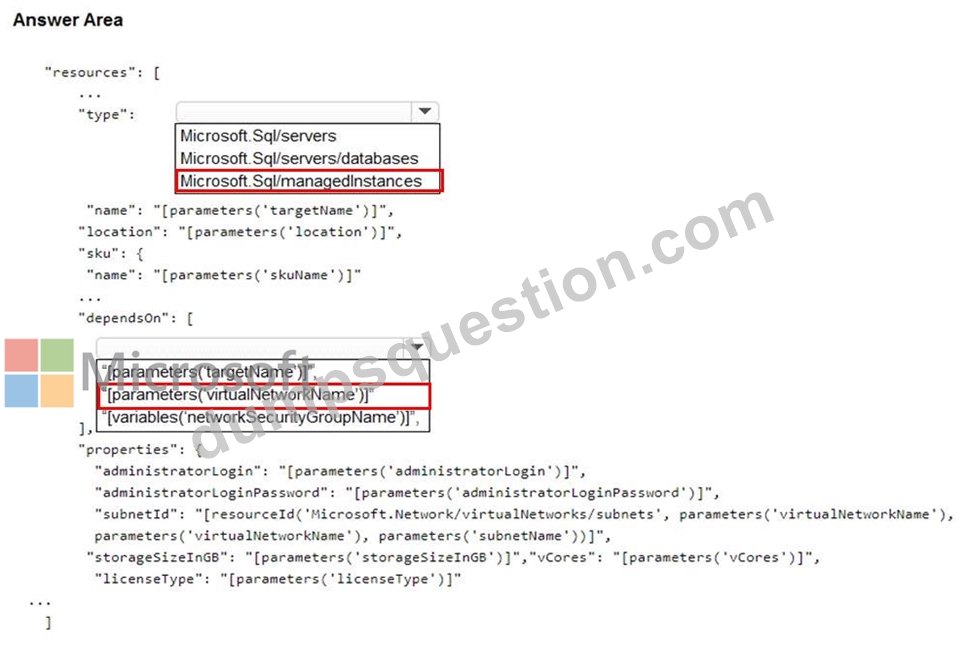
Reference:
https://docs.microsoft.com/en-us/azure/azure-sql/managed-instance/create-template-quickstart?tabs=azure-powershell
NEW QUESTION # 106
You have an Azure subscription that contains the resources shown in the following table.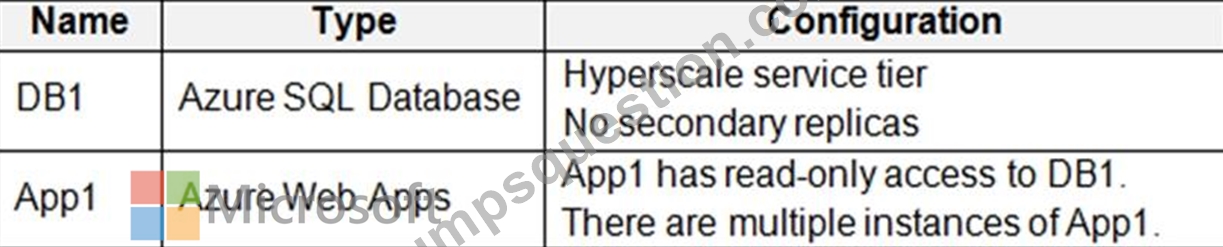
You need to create a read-only replica of DB1 and configure the App1 instances to use the replica.
What should you do? To answer, select the appropriate options in the answer area.
NOTE: Each correct selection is worth one point.
Answer:
Explanation: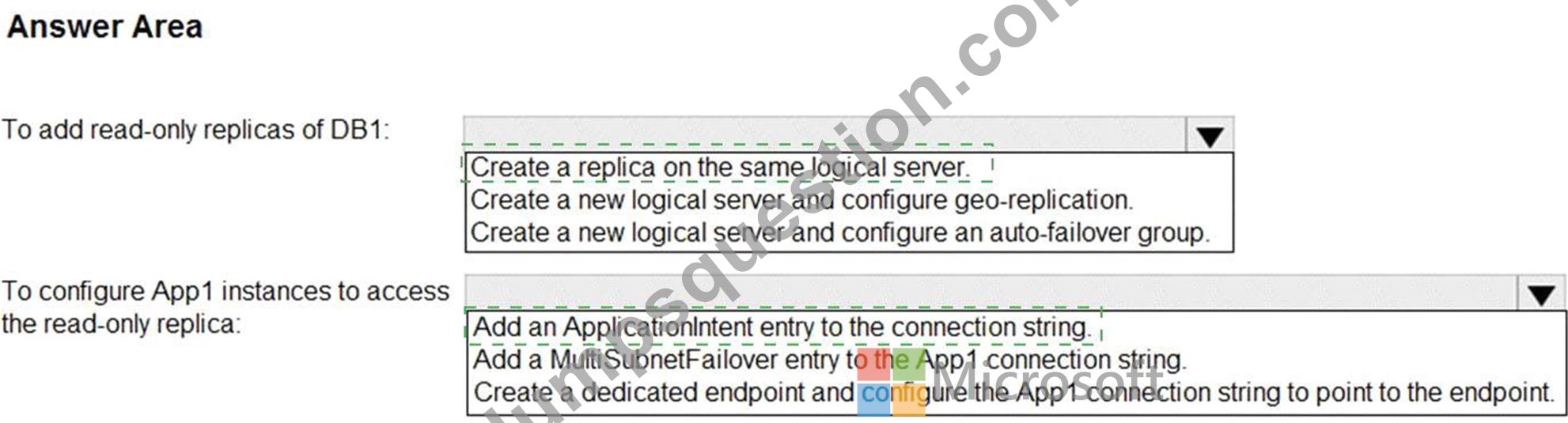
Explanation
Text Description automatically generated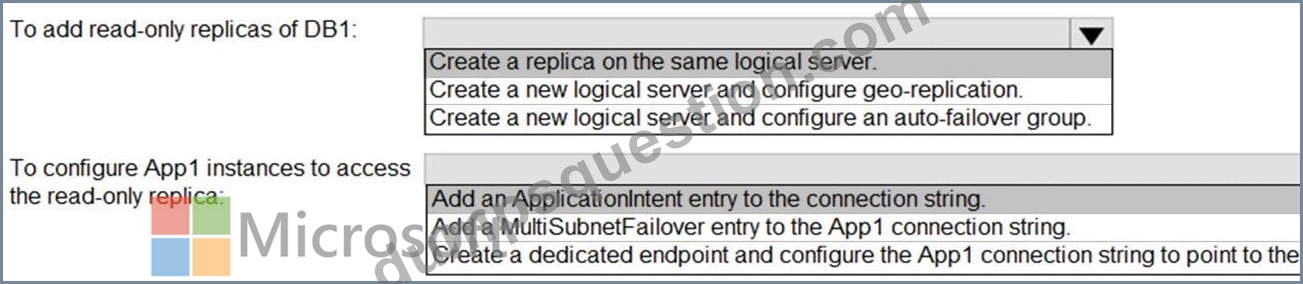
Reference:
https://sqlserverguides.com/read-only-replica-azure-sql/
NEW QUESTION # 107
You have an Azure SQL database that contains a table named Customer. Customer has the columns shown in the following table.
You plan to implement a dynamic data mask for the Customer_Phone column. The mask must meet the following requirements:
The first six numerals of each customer's phone number must be masked.
The last four digits of each customer's phone number must be visible.
Hyphens must be preserved and displayed.
How should you configure the dynamic data mask? To answer, select the appropriate options in the answer area.
Answer:
Explanation:
Reference:
https://docs.microsoft.com/en-us/sql/relational-databases/security/dynamic-data-masking
NEW QUESTION # 108
You have a 50-TB Microsoft SQL Server database named DB1.
You need to reduce the time it takes to perform database consistency checks of DB1.
Which Transact-SQL command should you run? To answer, select the appropriate options in the answer area.
NOTE: Each correct selection is worth one point.
Answer:
Explanation:
Explanation
Table Description automatically generated with low confidence
Reference:
https://docs.microsoft.com/en-us/sql/t-sql/database-console-commands/dbcc-checkdb-transact-sql?view=sql-serv
NEW QUESTION # 109
You are performing exploratory analysis of bus fare data in an Azure Data Lake Storage Gen2 account by using an Azure Synapse Analytics serverless SQL pool.
You execute the Transact-SQL query shown in the following exhibit.
Use the drop-down menus to select the answer choice that completes each statement based on the information presented in the graphic.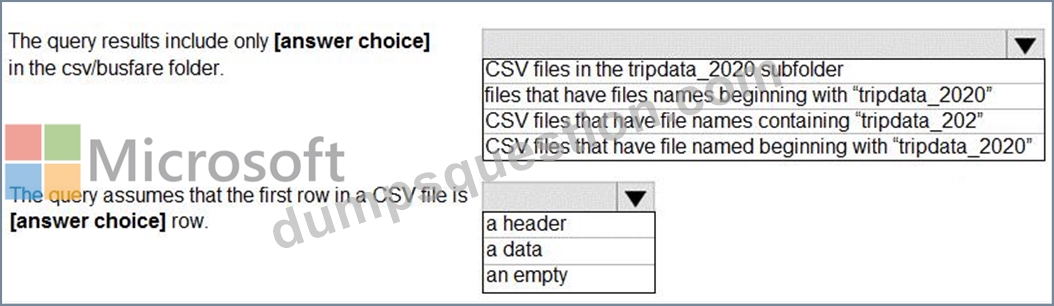
Answer:
Explanation: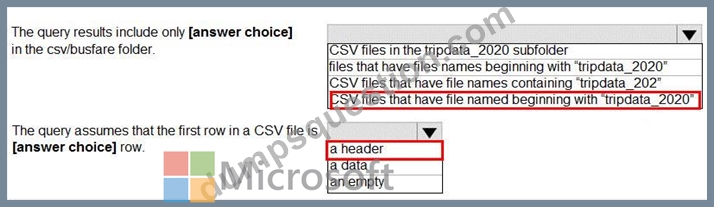
Reference:
https://docs.microsoft.com/en-us/azure/synapse-analytics/sql/develop-openrowset
NEW QUESTION # 110
You have an Azure SQL database.
You need to identify whether a delayed query execution is associated to a RESOURCE wait.
How should you complete the Transact -SQL statement? To answer, select the appropriate option in the answer area.
NOTE: Each correct selection is worth one point.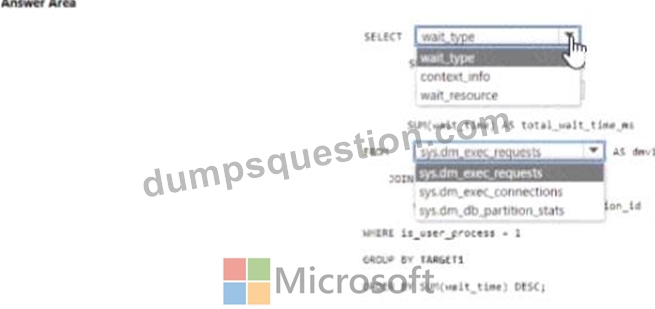
Answer:
Explanation: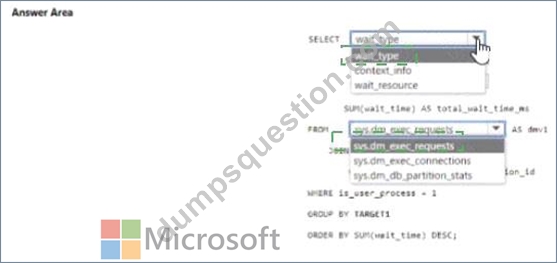
Explanation
NEW QUESTION # 111
You have a Microsoft SQL Server database named DB1 that contains a table named Table1.
The database role membership for a user named User1 is shown in the following exhibit.
Use the drop-down menus to select the answer choice that completes each statement based on the information presented in the graphic.
NOTE: Each correct selection is worth one point.
Answer:
Explanation:
Explanation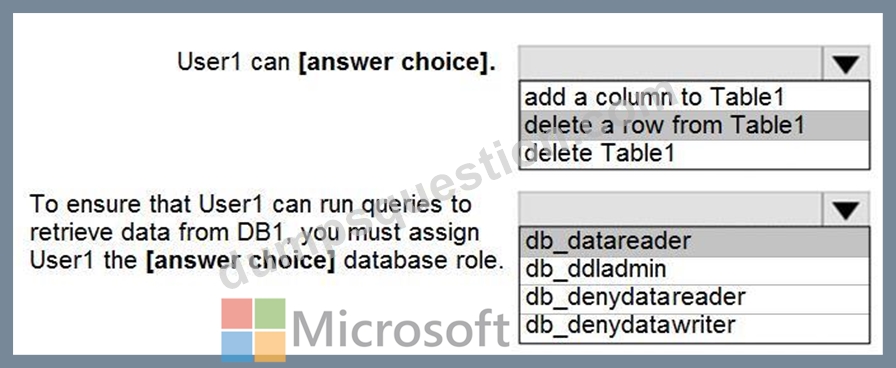
Box 1: delete a row from Table1
Members of the db_datawriter fixed database role can add, delete, or change data in all user tables.
Box 2: db_datareader
Members of the db_datareader fixed database role can read all data from all user tables.
Reference:
https://docs.microsoft.com/en-us/sql/relational-databases/security/authentication-access/database-level-roles
NEW QUESTION # 112
You manage an enterprise data warehouse in Azure Synapse Analytics.
Users report slow performance when they run commonly used queries. Users do not report performance changes for infrequently used queries.
You need to monitor resource utilization to determine the source of the performance issues.
Which metric should you monitor?
- A. Data Warehouse Units (DWU) used
- B. Cache hit percentage
- C. Local tempdb percentage
- D. DWU percentage
Answer: C
Explanation:
Section: [none]
Explanation:
Tempdb is used to hold intermediate results during query execution. High utilization of the tempdb database can lead to slow query performance.
Note: If you have a query that is consuming a large amount of memory or have received an error message related to allocation of tempdb, it could be due to a very large CREATE TABLE AS SELECT (CTAS) or INSERT SELECT statement running that is failing in the final data movement operation.
Reference:
https://docs.microsoft.com/en-us/azure/synapse-analytics/sql-data-warehouse/sql-data-warehouse-manage- monitor#monitor-tempdb
NEW QUESTION # 113
You have an Azure Data Lake Storage Gen2 account named account1 that stores logs as shown in the following table.
You do not expect that the logs will be accessed during the retention periods.
You need to recommend a solution for account1 that meets the following requirements:
Automatically deletes the logs at the end of each retention period
Minimizes storage costs
What should you include in the recommendation? To answer, select the appropriate options in the answer area.
NOTE:Each correct selection is worth one point.
Answer:
Explanation: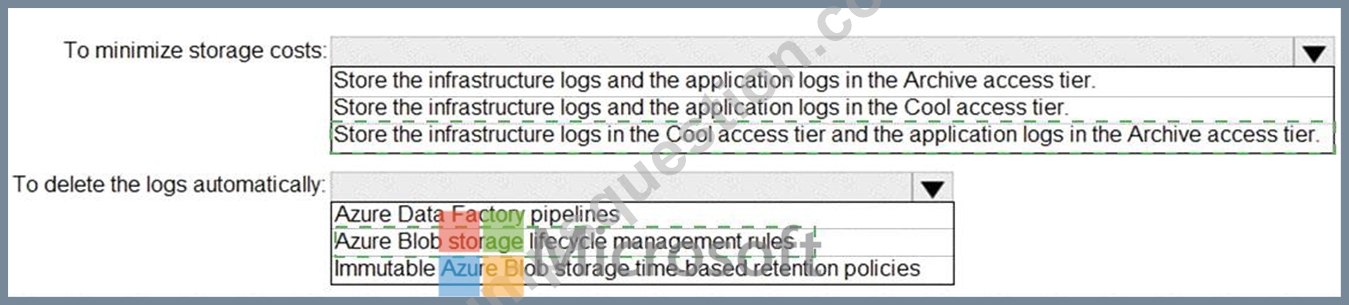
Explanation
A picture containing text Description automatically generated
Box 1: Store the infrastructure logs in the Cool access tier the application logs in the Archive access tier Hot - Optimized for storing data that is accessed frequently.
Cool - Optimized for storing data that is infrequently accessed and stored for at least 30 days.
Archive - Optimized for storing data that is rarely accessed and stored for at least 180 days with flexible latency requirements, on the order of hours.
Box 2: Azure Blob storage lifecycle management rules
Blob storage lifecycle management offers a rich, rule-based policy that you can use to transition your data to the best access tier and to expire data at the end of its lifecycle.
Reference:
https://docs.microsoft.com/en-us/azure/storage/blobs/storage-blob-storage-tiers
NEW QUESTION # 114
You have an Azure subscription.
You plan to deploy an Azure SQL database by using an Azure Resource Manager template.
How should you complete the template? To answer, select the appropriate options in the answer area.
NOTE: Each correct selection is worth one point.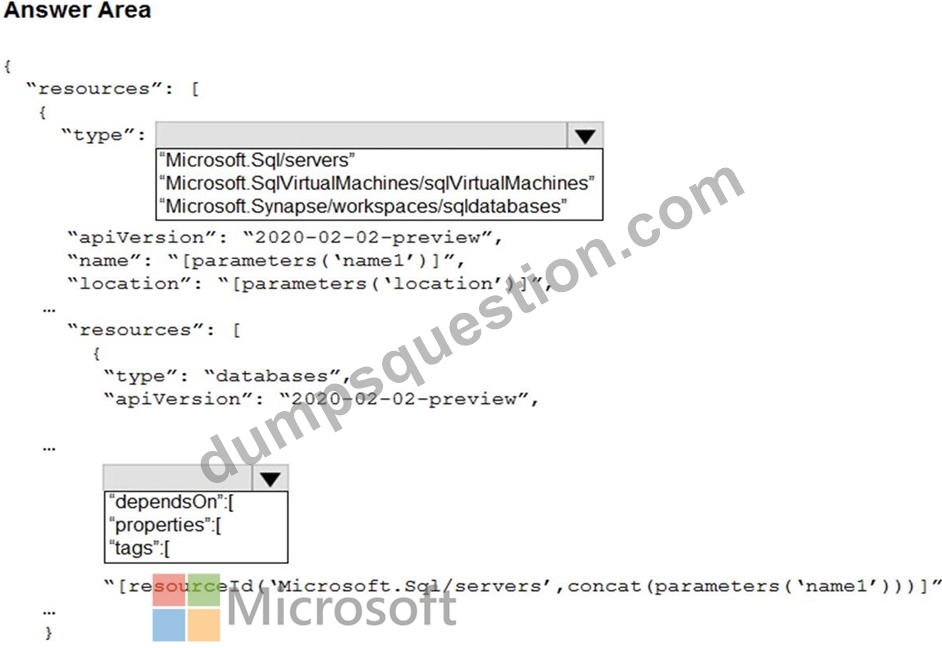
Answer:
Explanation:
Reference:
https://docs.microsoft.com/en-us/azure/azure-sql/database/single-database-create-arm-template-quickstart
NEW QUESTION # 115
You need to implement the monitoring of SalesSQLDb1. The solution must meet the technical requirements.
How should you collect and stream metrics? To answer, select the appropriate options in the answer area.
NOTE:Each correct selection is worth one point.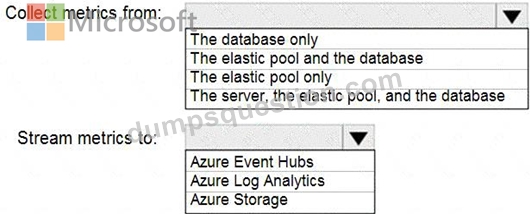
Answer:
Explanation: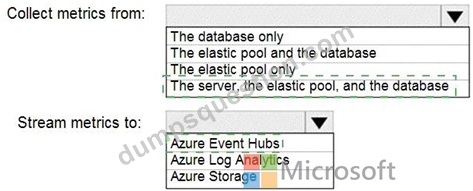
Explanation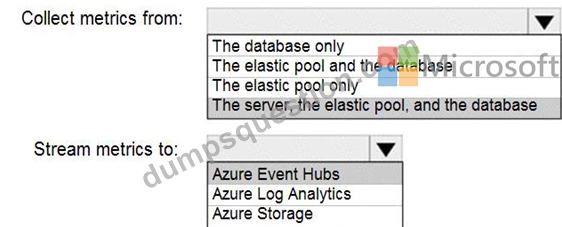
Box 1: The server, the elastic pool, and the database
Senario:
SalesSQLDb1 is in an elastic pool named SalesSQLDb1Pool.
Litware technical requirements include: all SQL Server and Azure SQL Database metrics related to CPU and storage usage and limits must be analyzed by using Azure built-in functionality.
Box 2: Azure Event hubs
Scenario: Migrate ManufacturingSQLDb1 to the Azure virtual machine platform.
Event hubs are able to handle custom metrics.
NEW QUESTION # 116
You have an Azure subscription.
You plan to migrate 10 on-premises Microsoft SQL Server instances to Azure.
You need to ensure that the migrated environment can be managed by using multiserver administration and supports master/target (MSX/TSX) jobs. The solution must minimize administrative effort.
Which SQL deployment options should you select as the master server (MSX) and the target server (TSX)? To answer, select the appropriate options in the answer area.
NOTE: Each correct selection is worth one point.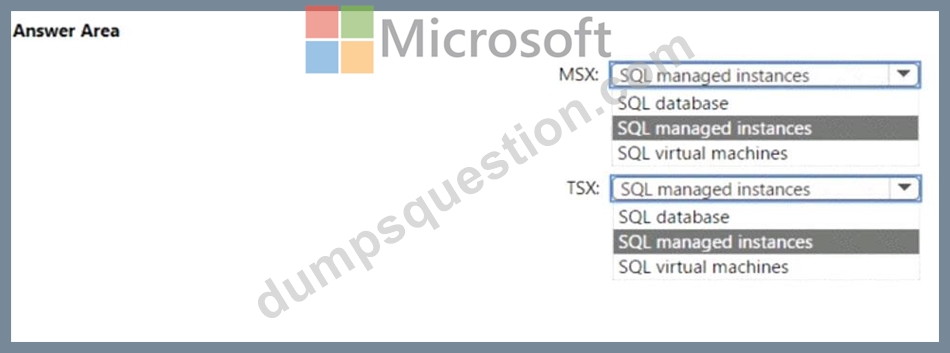
Answer:
Explanation: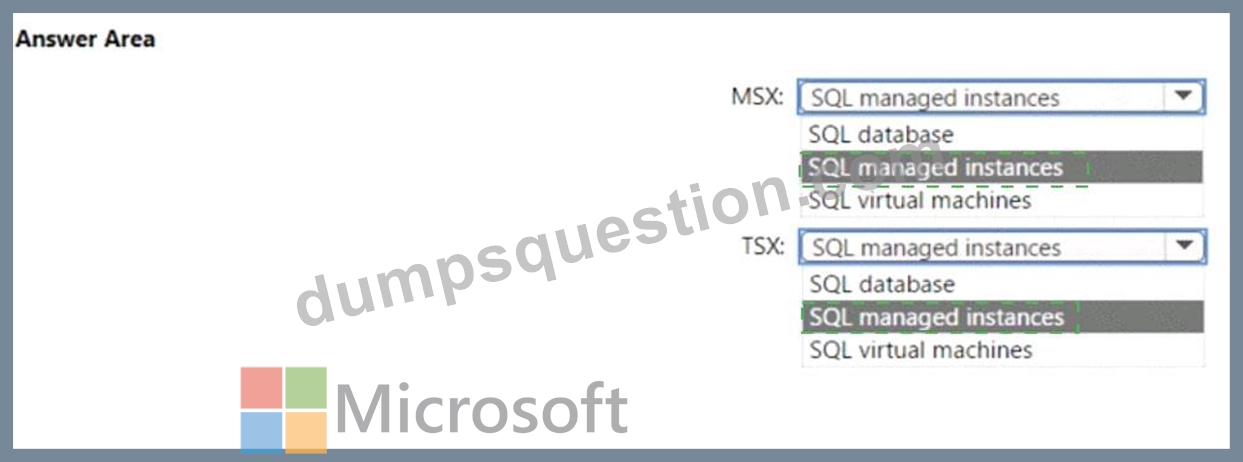
Explanation
NEW QUESTION # 117
You have SQL Server on an Azure virtual machine.
You need to use Policy-Based Management in Microsoft SQL Server to identify stored procedures that do not comply with your naming conventions.
Which three actions should you perform in sequence? To answer, move the appropriate actions from the list of actions to the answer area and arrange them in the correct order.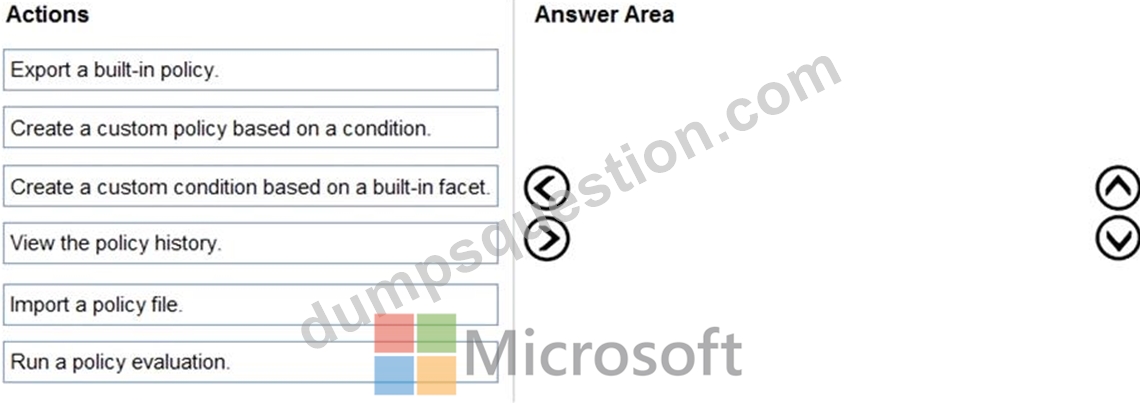
Answer:
Explanation: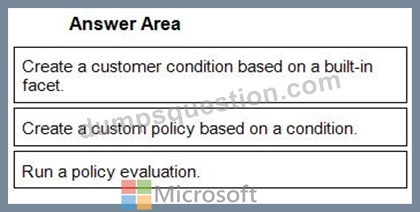
1 - Create a customer condition based on a built-in facet.
2 - Create a custom policy based on a condition.
3 - Run a policy evaluation.
Reference:
https://www.mssqltips.com/sqlservertip/2298/enforce-sql-server-database-naming-conventions-using-policy-based-management/
NEW QUESTION # 118
You have an Azure Data Factory that contains 10 pipelines.
You need to label each pipeline with its main purpose of either ingest, transform, or load. The labels must be available for grouping and filtering when using the monitoring experience in Data Factory.
What should you add to each pipeline?
- A. an annotation
- B. a correlation ID
- C. a run group ID
- D. a user property
- E. a resource tag
Answer: A
Explanation:
Explanation
Azure Data Factory annotations help you easily filter different Azure Data Factory objects based on a tag. You can define tags so you can see their performance or find errors faster.
Reference:
https://www.techtalkcorner.com/monitor-azure-data-factory-annotations/
NEW QUESTION # 119
You have an Azure SQL database named DB3.
You need to provide a user named DevUser with the ability to view the properties of DB3 from Microsoft SQL
Server Management Studio (SSMS) as shown in the exhibit. (Click the Exhibit tab.)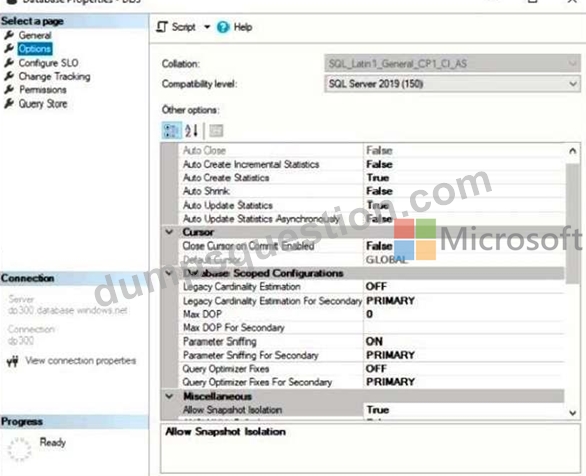
Which Transact-SQL command should you run?
- A. GRANT SHOWPLAN TO DevUser
- B. GRANT VIEW DATABASE STATE TO DevUser
- C. GRANT VIEW DEFINITION TO DevUser
- D. GRANT SELECT TO DevUser
Answer: B
Explanation:
Section: [none]
Explanation:
The exhibits displays Database [State] properties.
To query a dynamic management view or function requires SELECT permission on object and VIEW SERVER
STATE or VIEW DATABASE STATE permission.
Reference:
https://docs.microsoft.com/en-us/sql/relational-databases/databases/database-properties-options-page
NEW QUESTION # 120
A data engineer creates a table to store employee information for a new application. All employee names are in the US English alphabet. All addresses are locations in the United States. The data engineer uses the following statement to create the table.
You need to recommend changes to the data types to reduce storage and improve performance.
Which two actions should you recommend? Each correct answer presents part of the solution.
NOTE: Each correct selection is worth one point.
- A. Change PhoneNumber to the bigint data type.
- B. Change LastHireDate to the datetime2(7) data type.
- C. Change Salary to the money data type.
- D. Change PhoneNumber to the float data type.
- E. Change LastHireDate to the date data type.
Answer: C,E
NEW QUESTION # 121
......
Free DP-300 Exam Questions DP-300 Actual Free Exam Questions: https://examsdocs.dumpsquestion.com/DP-300-exam-dumps-collection.html